About
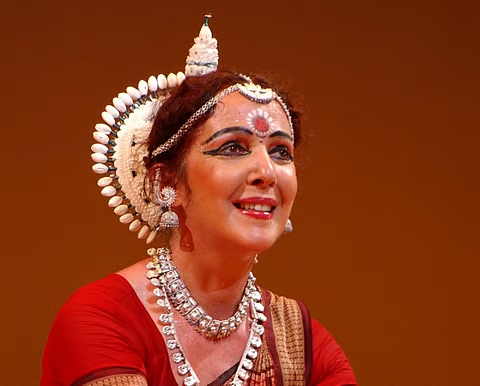
Ileana Citaristi is an Italian-born Odissi and Mayurbhanj Chhau dancer, choreographer, teacher, author, and founder-secretary of Art Vision in Bhubaneswar, Odisha. Born in Bergamo, Italy, she completed a doctorate in philosophy on “Psychoanalysis and Eastern Mythology” and worked for five years in traditional and experimental theatre in Italy before turning decisively toward Indian performance traditions. She came to India in 1979, first undertaking a short period of Kathakali study in Kerala and then relocating to Odisha, which has remained her home and artistic base.
Her principal Odissi training has been under Guru Kelucharan Mohapatra, beginning in 1979. She also undertook six years of Mayurbhanj Chhau training under Guru Hari Nayak and received the title of Acharya from Utkal Sangeet Mahavidyalaya, Bhubaneswar. Her work is rooted in the Kelucharan Mohapatra Odissi tradition while also drawing on her theatrical background and sustained engagement with Odisha’s martial, literary, visual, and ritual cultures.
Citaristi has made a distinctive contribution through choreography in both Odissi and Chhau, creating works that connect Indian classical movement vocabularies with literary, philosophical, ecological, and cross-cultural themes. Her documented productions include the Chhau works Echo and Narcissus, Pancha Bhuta, The Journey, Images of Change, Surya Devata, Jarjara, and Still I Rise, as well as Odissi works including Maya Darpan, Karuna, Kaala-Timebound, Siddhartha, Refugee, Meghadootam, Suta-The Thread, Duara Paka Nata, Make Room for Elephants, and Sharira. She has also worked as dance director for Aparna Sen’s Yugant, M. F. Husain’s Meenaxi: A Tale of Three Cities, and Goutam Ghose’s Abar Aranye.
Her legacy includes institution-building, pedagogy, writing, festival curation, and the transmission of Odissi and Mayurbhanj Chhau to Indian and international students through Art Vision. Art Vision organizes recurring cultural initiatives including Kalinga Mahotsav, Sangam, and Remembering Guruji. Her official institutional records document continuing choreography, teaching, festival leadership, performances, and recognition through 2025.
Legacy & impact
Ileana Citaristi’s legacy is multifaceted, spanning performance, pedagogy, choreography, cultural mediation, and documentation. Above all, she stands as a visible symbol of Odissi’s global embrace—an artist who arrived from Europe, rigorously trained within the classical parampara, and then returned the gift by dedicating her life to the ecology that nurtured her. This transnational arc helped normalize the presence of non-Indian practitioners within Odissi, without diluting the form’s grammar or its rootedness in Odia aesthetics. Her work affirmed that fidelity to a tradition is measured by discipline and comprehension, not by birthplace.
As a choreographer and director of Art Vision, she expanded Odissi’s dramaturgical ambit by building dance-theatre productions where narrative, music, and movement are interwoven with thoughtful stagecraft. In doing so, she gave Odissi and Chhau new contexts and audiences—often speaking across linguistic and cultural boundaries—while keeping technique uncompromised. Her production philosophy modeled a practical pathway for future choreographers: honor the classicism of the margam in solo repertory, and in ensemble work, experiment with narrative structures, lighting, and scenography to reach contemporary spectators.
Her books have become important reference points. “The Making of a Guru: Kelucharan Mohapatra—His Life and Times” not only memorializes her guru with rare first-person insight but also archives oral histories and the socio-cultural backdrop of the post-Independence revival of Odissi. “Traditional Martial Practices of Odisha/Orissa” preserves knowledge of indigenous martial lineages that feed into Chhau aesthetics and broader performative and ritual practices. In a field where documentation lags practice, these works enrich the literature available to students, scholars, and policy-makers.
Pedagogically, she is credited with training multiple generations at Art Vision, producing performers who teach and run companies both in India and abroad. Her method—combining rigorous physical conditioning with close textual study and an actor’s sensitivity—has influenced how some Odissi and Chhau teachers approach abhinaya and stage presence. Internationally, she has been a cultural bridge for Italian and European students seeking serious classical training, facilitating residencies in Bhubaneswar and creating touring opportunities.
Recognition today reflects this composite impact: the Padma Shri (2006) from the Government of India, state and national cultural honors, and an order of merit from the Italian Republic underscore how her work straddles two cultural spheres. Within Odisha’s arts community, her institution Art Vision is remembered for its collaborative ethos, for sustaining regular performance opportunities, and for presenting carefully researched thematic productions. As Odissi continues to evolve, her legacy endures in the students she has mentored, the choreographies in circulation, and the books that document a vital chapter of the form’s modern history.
Selected performances
International Meeting of Moving Theatre, Budapest
1985
International Tanz -Werkstat, Bonn
1985
Vignale Danza, Vignale
1986
Estate Fiesolana, Fiesole
1986
Internationale Tanzprojekt, Munster
1987
Second Latin-American Theatre Festival, Cordoba
1987
International Festival of Dance, Hong Kong
1989
Teatro Donizzetti, Bergamo
1990
Todi Festival, Todi
1991
Festival della Perdonanza, L'Aquila
1992
J.A.D.E. 93, Tokio più spettacoli a Tokushima, Hiroshima, Osaka, Kioto
1993
Festival Cortile Palazzo Pitti, Firenze
1994
Pergine Spettacolo Aperto, Pergine
1995
Settimana Internazionale della Danza, Rieti
1997
Festival dell'Infiorata , Genzano
1999
Congress on Dance Research, Corfù
2002
Orissa Society of the Americas, Ann Arbor
2003
XIII session of International School of Theatre Anthropology, Seville
2004
XIV session of International School of Theatre Anthropology, Wroclaw
2005
Performance and workshop at Seoul Institue of the Arts, South Korea
2006
Performance and workshop in Seoul Institute for the Arts, South Korea
2007
Performances of "I have a dream" at Teatro Massimo, Palerma, Italy
2008
The Bad Boys of Piano, Teatro Nazionale, Roma
2010
Danza Estate, Teatro Sociale, Bergamo
2010
Lotus Music and Dance Studia, New York,US
2011
Nehru Center, London, UK
2011
Odissi workshop and performance at Bharatiya Vidya Bhawan, London, UK
2012
Milpitas, CA, organised by Yuva Bharati
2015
Performance and workshop at Oxford University, UK
2016
London - Nehru Centre
2017
Solo Odissi ‘Shades of Love, at ex-church of Girignano, Sarnico, Italy
2019
Odissi workshop and Lec-Dem (on line) for IPAC, Singapore
2020
Presided and participated (on-line) in 'Shaping S-curves choreographic process' by UNC, Charlotte, USA
2021
Conducted Odissi workshop for Kala The Arts, Basingstoke, UK
2022
Odissi performance at Nehru Centre, Summer Workshop at Bhavan, London
2023
Odissi performance Racconti al Femminile at Palazzo Garderigo, Venice
2024
Solo Odissi program for Fringe, Teatro Cadorna, Milan
2025
Odissi workshop at La Sapienza University, Teatro Nuove Ateneo, Rome
2025
Timeline
- 1959BirthBorn on 1959-12-06 in Bergamo, Italy
- 1979First visit to IndiaTraveled to India to explore performance traditions and Indian classical dance
- 1981Began Odissi trainingCommenced rigorous training under Padma Vibhushan Kelucharan Mohapatra in Bhubaneswar
- 1982Began Mayurbhanj Chhau trainingStarted training under Guru Harihar Behera and Guru Krushna Chandra Naik
- 1984Early solo recitalsPresented early Odissi solo margams in Odisha and Kolkata, receiving critical encouragement
- 1988International touringExpanded performance tours across Europe and Asia, presenting Odissi and Chhau
- 1990Teaching beginsBegan mentoring students and conducting workshops in India and abroad
- 1996Founded Art VisionEstablished Art Vision in Bhubaneswar as a centre for training and production in Odissi, Chhau, and dance-theatre.
- 2001Launched collaborative seriesInitiated Art Vision’s annual collaborative performance platform (later referred to as Sangam)
- 2001Book on Kelucharan MohapatraPublished “The Making of a Guru: Kelucharan Mohapatra—His Life and Times”
- 2004Major thematic productionStaged a large-scale work combining Odissi and Chhau vocabularies on an Odishan historical theme
- 2006Padma ShriAwarded the Padma Shri by the Government of India for contributions to the arts
- 2008Italian state honourConferred the Order of the Star of Italian Solidarity (Cavaliere) by the President of Italy
- 2012Book on martial practicesPublished “Traditional Martial Practices of Odisha/Orissa” documenting Paika and Chhau
- 2016Sangeet Natak Akademi AwardReceived the SNA Award for Odissi
- 2020Digital and intimate-stage workContinued mentoring and staging works, adapting to hybrid/digital formats as needed
- 2023Ongoing legacyActive in Bhubaneswar with Art Vision, training and creating new choreographies