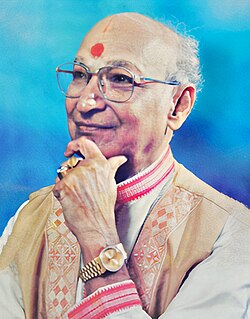
Suramani Padit Raghunath Panigrahi
Odissi Guru · 1934–2013
Pandit; Odissi vocalist and composer; Playback singer; Co-architect of modern Odissi dance music
Padma Shri Raghunath Panigrahi (1934-08-10 – 2013-08-25) was the iconic Odissi vocalist whose mellifluous voice and musical vision shaped the sound, grammar, and international projection of Odissi dance and music in t…
About
Padma Shri Raghunath Panigrahi (1934-08-10 – 2013-08-25) was the iconic Odissi vocalist whose mellifluous voice and musical vision shaped the sound, grammar, and international projection of Odissi dance and music in the latter half of the 20th century. Born into a culturally rooted Odia family (widely associated with Puri and the Odissi tradition), he imbibed music early at home and through the community of temple and classical musicians active in coastal Odisha. As a youth, he was drawn to classical poetry, especially Jayadeva’s Gita Govinda, which would later become his lifelong canvas. He trained rigorously in Odissi music and also absorbed elements of Hindustani and Carnatic aesthetics that broadened his vocal palette. By his late teens he was already singing for All India Radio (AIR) and had begun to develop the precise enunciation, sruti-shuddha intonation, and emotive bhava that would become his signature.
In the 1950s and early 1960s, Panigrahi briefly pursued a promising career as a playback singer in the south Indian film industry (Madras/Chennai), where his clearly articulated diction and supple range found favor (details of individual films are less widely documented). Yet, in what has passed into Odissi lore, he gave up the security of that career to devote himself wholly to Odissi and to the artistic partnership with the great Odissi dancer, Padma Shri Sanjukta Panigrahi, whom he married in 1960. This choice changed the course of Odissi dance and music: the Panigrahis became a pioneering duo, carrying Odissi to global stages and defining a musical-dance idiom that countless artistes would follow.
A decisive turn in his artistic journey came through his close creative partnership with the violin virtuoso-composer Pandit Bhubaneswar Mishra. Together, Panigrahi and Mishra forged a modern concert grammar for Odissi dance: sculpting ragas, talas, and lyrical pacing tailored to abhinaya (expressive storytelling) and nritta (pure dance), while preserving Odissi’s identity. Their settings of Jayadeva’s ashtapadis—such as Yahi Madhava, Sakhi he keshi-mathana-mudaram, Nindati Chandana, and Priye Charusheele—became canonical. Panigrahi’s voice—honeyed yet architecturally precise—crafted an emotional landscape for Sanjukta’s abhinaya. Their AIR broadcasts and HMV/INRECO recordings disseminated these versions widely; generations of dancers learned Odissi abhinaya to his renditions, often by heart, just from those LPs and cassettes.
Through the 1960s to the 1990s, Panigrahi toured extensively across India and abroad, frequently under the auspices of the Indian Council for Cultural Relations (ICCR), performing in Europe, the United States, the Soviet Union, and Southeast Asia. On stage, he was the anchor of the Odissi ensemble, cueing tempo changes, supporting mardala cadences, and breathing life into sahitya. Off stage, he was deeply scholarly—studying variant Odissi raga-lakshanas, older paddhati traditions, and textual nuances of Gita Govinda, Champu, Chhanda, and Odia bhajan poetry. He nurtured a style where musical sophistication never eclipsed the sahitya-bhava; lyrics remained intelligible and emotionally immediate.
As a teacher and rehearsal director, Panigrahi was exacting but nurturing. He demanded impeccable diction of Sanskrit/Odia, adherence to Odissi raga prayogas, and rhythmic discipline aligned with mardala bols. His rehearsals were famed for their “svara-bhava-artha” triad—pitch purity, emotive import, and textual meaning—driven by a methodical approach: slow delineation of sthayi for mood-setting, judicious use of meend and gamaka, and clear sam landing to support a dancer’s chauka geometry. He coached not only singers but also dancers, believing every Odissi dancer must internalize the song-text; he often workshopped abhinaya sahitya line-by-line, indicating precise lyrical accents that trigger mudra transitions.
After the untimely passing of his wife Sanjukta in 1997, Panigrahi established the Smt. Sanjukta Panigrahi Memorial Trust (1999) to preserve and propagate Odissi, curate archives, and support young artistes. He continued to perform, lecture, and mentor, revisiting classic ashtapadis while also presenting lesser-heard Odissi compositions and bhajans. In later years, he served as a visiting guru and resource person to institutions and festivals, adjudicated competitions, and remained the go-to vocalist for traditional abhinaya repertoires. Even in his final decade, his voice retained its clarity and emotional charge, and his counsel was sought by both senior gurus and the rising generation.
Panigrahi’s personal character combined humility with unwavering artistic standards. He was known for his quiet stage presence, courtesy to accompanists, and a lifelong fidelity to Odissi idiom over flashy display. He passed away on 2013-08-25 in Bhubaneswar, triggering an outpouring of tributes from the dance and music fraternity. His recordings, many now digitized, continue to be teaching texts for Odissi musicians and dancers; his approach to Gita Govinda and abhinaya sahitya remains the benchmark by which interpretations are measured.
Legacy & impact
Raghunath Panigrahi’s legacy is inseparable from the global renaissance of Odissi after Independence. He helped stabilize a concert-ready Odissi music grammar that could sustain large proscenium presentations while maintaining lineage integrity. By pairing the tensile strength of a classically grounded voice with poetic sensitivity to Jayadeva and Odia sahitya, he made the text intelligible and emotionally resonant to audiences unfamiliar with the language—vital for international tours. His collaborations with Pandit Bhubaneswar Mishra effectively canonized a repertoire that is now standard pedagogy: their tunings, raga choices, and tala designs for key ashtapadis and abhinaya items (mangalacharan, batu nritya accompaniment cues, pallavi transitions, and moksha cadences) are still used or referenced by most schools of Odissi.
He also re-centered the vocalist’s role in Odissi ensembles. Rather than a generic “accompanist,” the vocalist became the dramaturgical axis—interpreting text, pacing dance, and dialoguing with mardala and violin. Panigrahi’s insistence on clear Sanskrit/Odia diction and bhava-driven phrasing influenced vocalists across Odisha and beyond, shaping the pedagogy of gurus who came after him. His recordings—especially of Gita Govinda—are the de facto textbooks for abhinaya classes, often played repeatedly so dancers can absorb not just melody but micro-accent and breath. In this sense, he is a “guru of gurus,” because even gurus who never studied formally with him absorbed his interpretive values.
Institutionally, the Smt. Sanjukta Panigrahi Memorial Trust seeded scholarships, festivals, and archival initiatives, giving young artistes platforms and materials. His presence as a mentor at workshops and residencies in Bhubaneswar, Delhi, Kolkata, Chennai, and internationally nurtured a large informal circle of disciples. Today, he is remembered in annual memorial concerts, special lecture-demonstrations on Gita Govinda sanchari bhavas, and curated reissues of his classic LPs. His name is invoked alongside the foundational architects of modern Odissi—Padma Vibhushan Kelucharan Mohapatra (dance), Pandit Bhubaneswar Mishra (music), and mardala greats—because Panigrahi provided the voice that made Odissi’s poetry breathe. His legacy endures every time an Odissi dancer mouths a line of Jayadeva to the exact inflection he set decades ago.
Timeline
- 1934BirthBorn on 1934-08-10 in Gunupur a small town in the backward south Odisha district of Koraput on the banks of river Vamsadhara
- 1952Advanced training and AIR broadcasts beginAs a young adult, pursues rigorous Odissi music training and begins singing for All India Radio (Cuttack)
- 1960Marriage to Sanjukta PanigrahiMarries Odissi dancer Sanjukta Panigrahi, forging an artistic partnership that would define Odissi’s modern stage era.
- 1961Leaves film playback career for OdissiAfter a promising stint in Madras playback singing, chooses to devote himself fully to Odissi music and Sanjukta’s dance career.
- 1963Begins canonical Gita Govinda workWith Pandit Bhubaneswar Mishra, begins formalizing Odissi music settings of Jayadeva’s ashtapadis for dance.
- 1966First major ICCR tourUndertakes an early ICCR-sponsored overseas tour with Sanjukta, presenting Odissi in Europe and beyond.
- 1970Landmark recordingsHMV/INRECO releases of Gita Govinda and abhinaya items start circulating, becoming standard teaching references.
- 1993State recognitionHonoured by Odisha Sangeet Natak Akademi for contributions to Odissi music
- 1997Personal lossSanjukta Panigrahi passes away (1997-06-24); he continues their mission of preserving Odissi.
- 1999Establishes Memorial TrustFounds the Smt. Sanjukta Panigrahi Memorial Trust to support Odissi artistes, research, and archiving.
- 2005Mentorship and workshopsIntensifies teaching, workshops, and mentorship across India; becomes a guiding voice for abhinaya pedagogy.
- 2010Padma ShriAwarded the Padma Shri by the Government of India for his contribution to the arts (music).
- 2012National commemoration honourReceives Tagore 150th year commemoration honour from SNA/Ministry of Culture (as part of nationwide recognitions).
- 2013PassingPasses away in Bhubaneswar on 2013-08-25; the Odissi community mourns the loss of its most beloved voice.