About
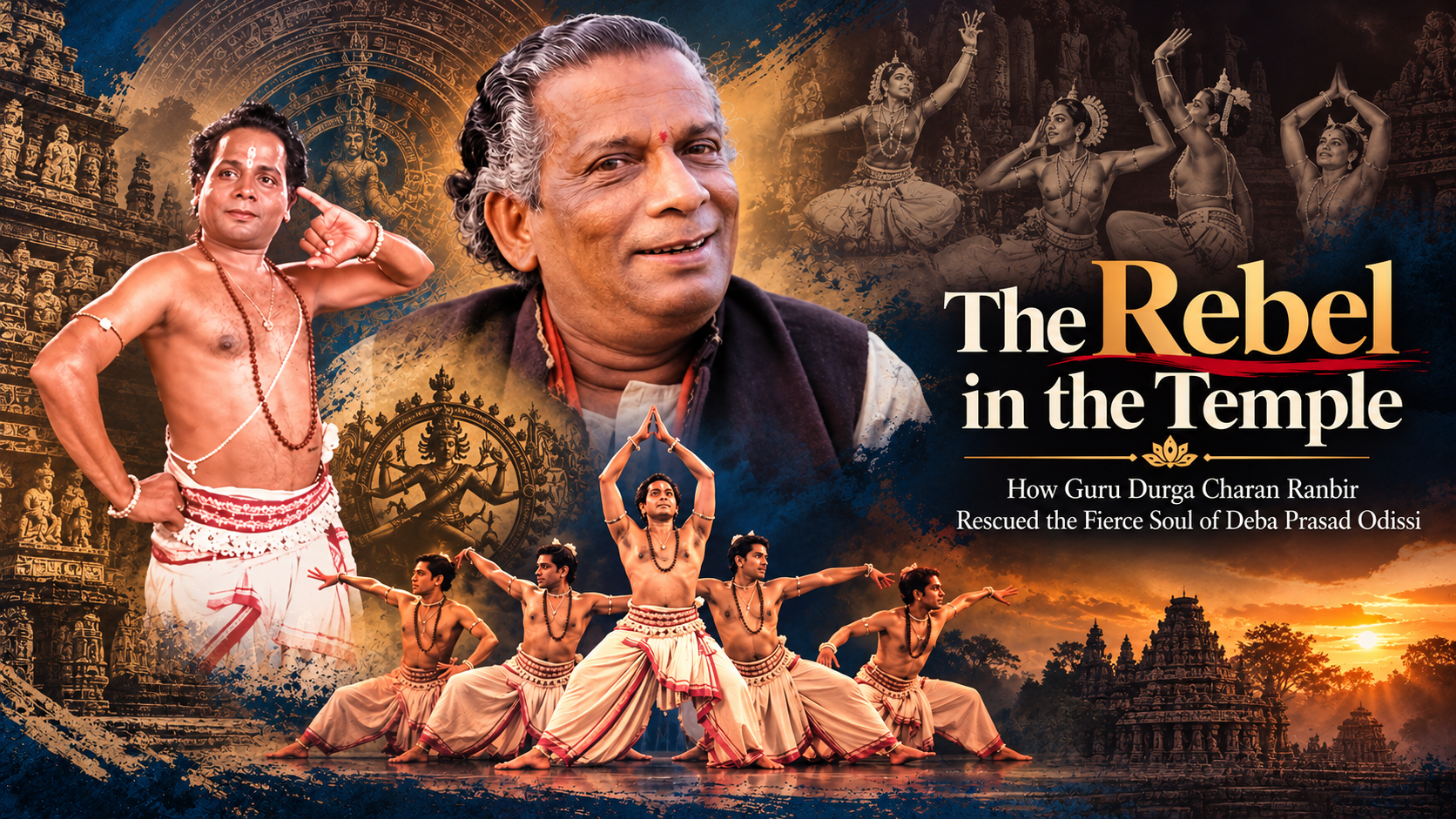
Durga Charan Ranbir is a senior Odissi guru and choreographer widely recognized as one of the foremost torchbearers of the Deba Prasad Das gharana of Odissi. Born in Kamaguru village, Odisha, India, he grew up amid the state’s rich matrix of classical, folk, and ritual performance traditions. Early exposures to temple-centered and community ritual forms, including robust martial-kinetic idioms and percussion-driven group practices, left lasting impressions on his aesthetic sensibility. From a young age he gravitated to dance, receiving initial guidance from local teachers before coming under institutional training. The turning point of his artistic life was his rigorous tutelage under the legendary Odissi master Deba Prasad Das at Utkal Sangeet Mahavidyalaya, Bhubaneswar, where Ranbir absorbed not only technique but a distinctive philosophy of performance that married classical grammar with the kinetic energies of Odisha’s folk and ritual performance ecology.
As a principal disciple of Deba Prasad Das, Ranbir imbibed the gharana’s defining markers: a powerful chauka, emphatic rhythmic architecture, sabda-swara-pata (mnemonic syllabic dance passages), a strong dramatic sense in abhinaya, and a vocabulary inflected by ritual-tribal and folk idioms such as sahi nata and danda nacha. After the passing of his guru in 1986, Ranbir emerged as a key inheritor of the style, diligently reconstructing, preserving, and teaching seminal compositions while also extending the repertoire with his own choreographies that remained faithful to the gharana’s texture. He served for decades on the faculty of Utkal Sangeet Mahavidyalaya (USM), mentoring several generations of students and eventually shouldering senior academic and mentoring responsibilities. His classes became known for uncompromising training in chauka and tribhangi alignment, tala-laya literacy, and an insistence on the dramatic truth of abhinaya over mere prettiness.
Ranbir’s stage career includes numerous performances at India’s major classical dance platforms—Konark Dance Festival, Khajuraho Dance Festival, Mukteswar Dance Festival, and other state and national festivals—both as a soloist and as choreographer-director of ensemble works. He has been frequently invited to lecture-demonstrate the specificities of the Deba Prasad style in academic forums, art universities, and cultural centers in India and abroad, addressing topics such as sabda-swara-pata structures, the rhetorical-muscularity of chauka, and the synthesis of folk-classical energies in the gharana’s pedagogy. His choreography has focused on re-centering core forms—Mangalacharan, Batu, Pallavi, Abhinaya, and Moksha—in a manner that foregrounds rhythmic sophistication and characterful dramaturgy, often highlighting percussion dialogues with mardala. He has revived and systematized a number of older mnemonic passages and ritual-dance motifs (such as sahi nata-derived idioms) within the classical score so that they can be transmitted reliably to future generations.
As a teacher, Ranbir is renowned for a steady, detail-oriented talim. Students recall classes beginning with long, exacting chauka-khanda drills, transitioning into rhythmic phrases that map syllabic mnemonics to footwork, torso isolations, and hastas, and finally to abhinaya explorations steeped in sahitya comprehension. He places equal emphasis on angika (physical expression) and satvika (internal emotive truth), encouraging dancers to cultivate a grounded center and to understand why a gesture exists in a phrase rather than simply reproducing it. Rather than chasing novelty, his method has emphasized clarity of line, rhythmic command, and an intense, dignified energy that is emblematic of his guru’s thought-world. At the same time, he has created new works that converse with contemporary aesthetics without sacrificing the stylistic integrity of the gharana.
Ranbir’s contribution extends beyond choreography and stagecraft into documentation and pedagogy. He has been involved in reconstructing and notating compositions of the Deba Prasad repertoire, clarifying tala structures and the placement of sabda-swara-pata within choreographic arcs, and standardizing teaching progressions from elementary adavus to advanced nritta and abhinaya. He helped consolidate networks of Deba Prasad-lineage dancers and percussionists, fostering collaborations that ensured faithful transmission of stylistic nuance. Several of his disciples have established their own schools in India and overseas, spreading the gharana globally. In his later years, he has remained active as a mentor, examiner, and visiting guru, continuing to coach advanced students for major festivals, exams, and arangetrams, and advising on repertory curation and stylistic fidelity.
Personal accounts emphasize his quiet authority, patience, and exactitude. He is reputed to be sparing with praise but generous with time and meticulous corrections. He favors building dancers ‘from the ground up’—feet, knees, hips, spine—before allowing complex choreographies, and he insists on a deep engagement with Odia literature and music as the bedrock of interpretive dance. Though best known for preserving the Deba Prasad signature, Ranbir’s oeuvre demonstrates that rigorous classicism and vibrant, lived rhythmicity can sustain and speak to contemporary audiences when taught and performed with conviction.
Legacy & impact
Durga Charan Ranbir’s most enduring legacy is his steadfast custodianship of the Deba Prasad Das gharana of Odissi at a time when homogenization threatened to erase gharana-specific textures. By codifying training progressions, restoring sabda-swara-pata passages, and retaining the muscular, earth-bound energy of the style, he safeguarded a valuable aesthetic lineage and ensured that students could access it with clarity and rigor. His decades of teaching at Utkal Sangeet Mahavidyalaya created a pipeline of well-trained dancers who, in turn, seeded institutions and repertory ensembles across India and the diaspora, transmitting the gharana to new contexts without losing its core identity.
Ranbir’s insistence on tala literacy and mardala-dialogue sensitized a generation of dancers to rhythmic architecture as the foundation of Odissi. This emphasis has shaped how many performers now build and present pallavis and nritta sequences, privileging clarity of layakari, dynamic use of stillness, and the satisfying weight of chauka over superficial flourish. His revival and systematization of sahi nata-derived idioms, and his dramaturgical approach to abhinaya, have likewise broadened the canon of what is considered ‘classical’ within Odissi, keeping alive the porous boundary between ritual-folk and temple-classical that historically characterized the form.
Internationally, Ranbir’s students and collaborators have brought the Deba Prasad style to stages and classrooms across North America, Europe, and East Asia, expanding both audience awareness and practitioner networks. Within Odisha, he stands as a reference point for style-specific authenticity: organizers and institutions routinely seek his mentorship for curations that require a Deba Prasad lens. Today he is remembered not only as a formidable teacher and choreographer but also as a thinker-practitioner whose work demonstrates that tradition thrives best when its grammar is precisely transmitted and critically understood. His impact is visible in the repertories of numerous younger artists, in the syllabi of institutions that reflect his pedagogy, and in the continuing appeal of a distinct Odissi voice that he helped keep vibrant.
Timeline
- 1951BirthBorn in Odisha, India
- 1960Early exposure to Odia folk/ritual formsIntroduced to community and ritual performance practices that later shaped his aesthetics
- 1970Formal Odissi training beginsCommenced rigorous Odissi training; soon came under Guru Deba Prasad Das at Utkal Sangeet Mahavidyalaya, Bhubaneswar
- 1976Early professional performancesBegan performing widely in Odisha and neighboring states
- 1980Joined teaching facultyStarted teaching Odissi at Utkal Sangeet Mahavidyalaya, Bhubaneswar
- 1986Stewardship of Deba Prasad gharanaFollowing the demise of Guru Deba Prasad Das, took up active custodianship of the gharana’s repertory and pedagogy
- 1990Reconstruction and notation initiativesSystematized sabda-swara-pata passages and documented key compositions for pedagogy
- 1993Established Nrityayan in BhubaneswarFounded an Odissi school to disseminate the Deba Prasad style
- 1995National festival circuitRegular presentations at Khajuraho, Konark, and other national festivals
- 2005Senior academic mentorGuided advanced students and contributed to curriculum and examination frameworks at USM
- 2005Sangeet Natak Akademi AwardHonored with the national SNA Award for Odissi
- 2010New choreographies premieredPresented new works consolidating gharana identity while engaging contemporary audiences
- 2025Padma ShriConferred by the Government of India for distinguished service in the field of art.