Legacy · Odissi
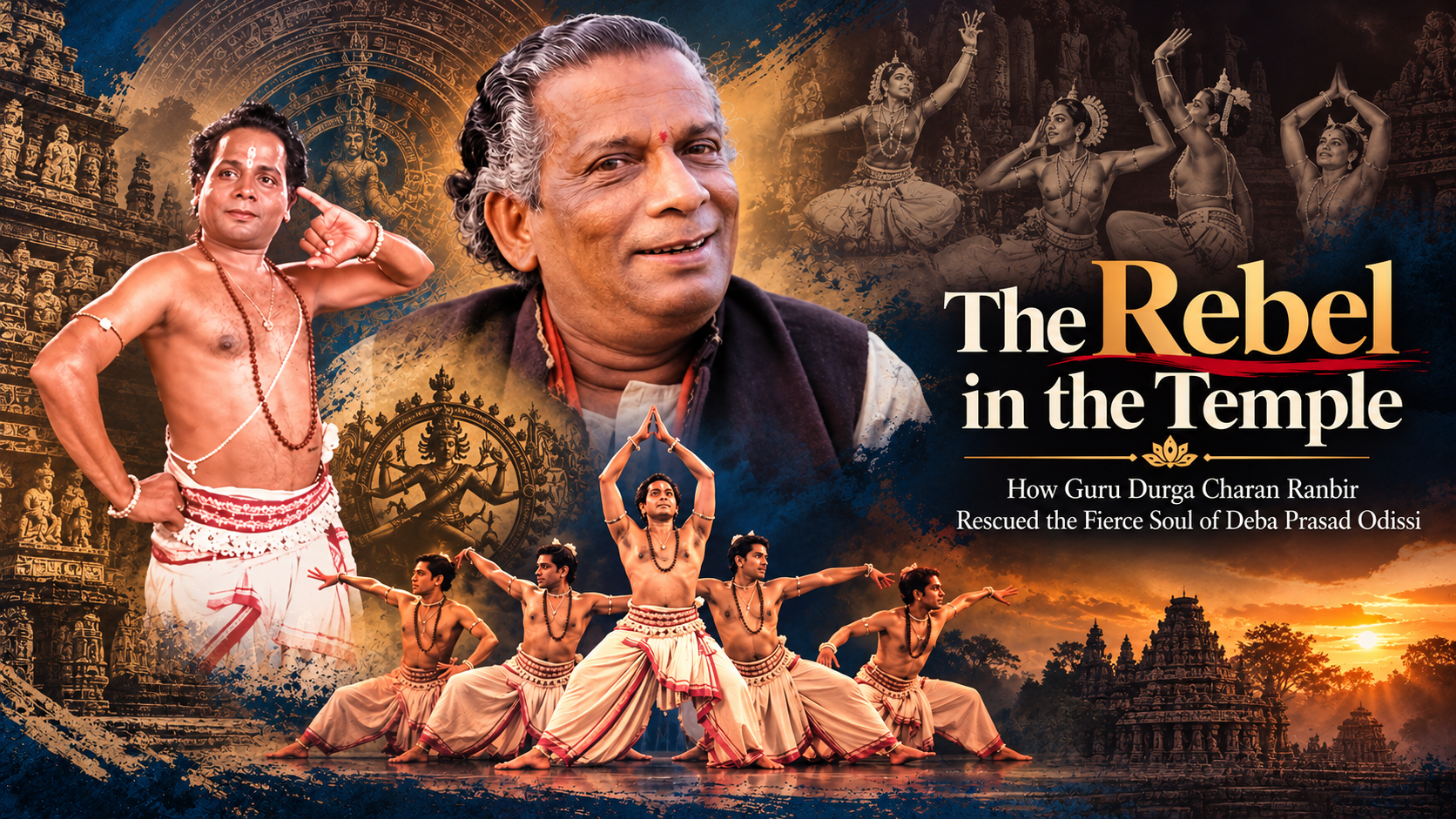
The Rebel in the Temple
How Guru Durga Charan Ranbir Rescued the Fierce Soul of Deba Prasad Odissi
When mid-century stages softened Odissi into delicate lyrical curves, one rebellious master looked back to tribal roots and Shaivite thunder—forging a lineage of disciples who proved that grace can have sharp edges.
Taalika Editorial · Friday, 18 September · 3 min read
Every classical tradition eventually falls into the trap of its own beauty.
By the late 1970s, Odissi had triumphed. It was celebrated across global prosceniums for its fluid tribhanga, its liquid torso movements, and the intoxicating Vaishnavite sweetness of Jayadeva’s Gita Govinda. But beneath that lush lyricism, a quiet conformity settled in. Audiences and critics began to expect Odissi to look only one way: soft, delicate, and ornamental.
Yet in the shadows of the ancient temple corridors lingered an unresolved ache: Had the dance sacrificed its raw, primordial pulse just to appear polite on modern concert stages?
The Firebrand of the Tridhara
Guru Durga Charan Ranbir knew another truth lived in the soil of Odisha.
Trained under the legendary iconoclast Guru Deba Prasad Das, Ranbir inherited the uncompromising philosophy of Tridhara—the three-stream lineage merging Jaiva (tribal energy), Gramya (folk vitality), and Shastriya (classical architecture). While the rest of the classical fraternity leaned toward refined courtly grace, Deba Prasad and Ranbir looked toward the rugged Shaivite shrines, the fierce Tantric temples of the Prachi Valley, and the primal thrum of tribal rhythm.
When Deba Prasad Das passed away prematurely in 1986, the Deba Prasad gharana faced an existential threat. Connoisseurs murmured that without its charismatic pioneer, this earthbound, rhythmic style would slowly vanish beneath the dominant, softer schools.
Ranbir refused to let that fire burn out.
He took on the mantle not as a passive caretaker of museum relics, but as an unrelenting standard-bearer. He set about proving that Odissi did not need to apologize for its sharp angles, its crisp jumps, its explosive sabdas, or its percussive footwork that hit the floor like lightning.
The Sacred Thunder
Ranbir's laboratory became the bridge between forgotten temple stones and living proscenium electricity.
He dug into rare Shaiva and Shakta repertoires, bringing forgotten manuscripts and ritual stotras to light. His choreography abandoned easy, saccharine gestures. When he shaped the tandava of Shiva or the fierce invocation of Mahakali, the dancer wasn’t miming decorative deities; they were channeling primordial forces.
The questions from skeptics were relentless: Can an audience accustomed to pure sweetness stomach such unvarnished power? Can Odissi still be Odissi when it strikes like thunder?
Ranbir answered not with theory, but through the discipline of the body. He trained his students with grueling athletic precision, demanding that every chauka sink deep into the earth and every leap land without compromising classical geometry.
The Torchbearers of the Flame
Ranbir knew that an embattled tradition survives only if young bodies are willing to bleed for it.
He opened his gurukul in Bhubaneswar and traveled relentlessly, cultivating a vanguard of dancers who carried the Deba Prasad legacy to world stages:
-
Rahul Acharya, his foremost male disciple, stunned international audiences with electrifying masculine vigor, proving that male Odissi could possess majestic technical authority and virtuosic stamina, eventually receiving the Sangeet Natak Akademi’s Ustad Bismillah Khan Yuva Puraskar.
-
Rajashri Praharaj, embodying the style’s intricate balance of sculptural stillness and rhythmic speed, showing that a female dancer could wield power and razor-sharp clarity without shedding classical poise.
-
Bichitranda Swain, who initially imbibed the raw energy of the gharana before establishing Rudraksha Foundation, cementing the dynamic athletic resonance of male ensembles worldwide.
-
Next-generation disciples across Odisha and the global diaspora who continue to train under his watchful gaze, ensuring that the distinct Tridhara identity remains uncompromised.
The circle was forged.
Because Durga Charan Ranbir refused to soften the corners of his guru's vision, Odissi retained its plural soul. Today, when a dancer charges across the stage with the fierce stomp of a warrior, carves the air with the raw energy of Sabari, or stands resolute in a deep, unflinching Chauka, they breathe the untamed spirit of a master who kept the fire burning.