Spotlight · Odissi
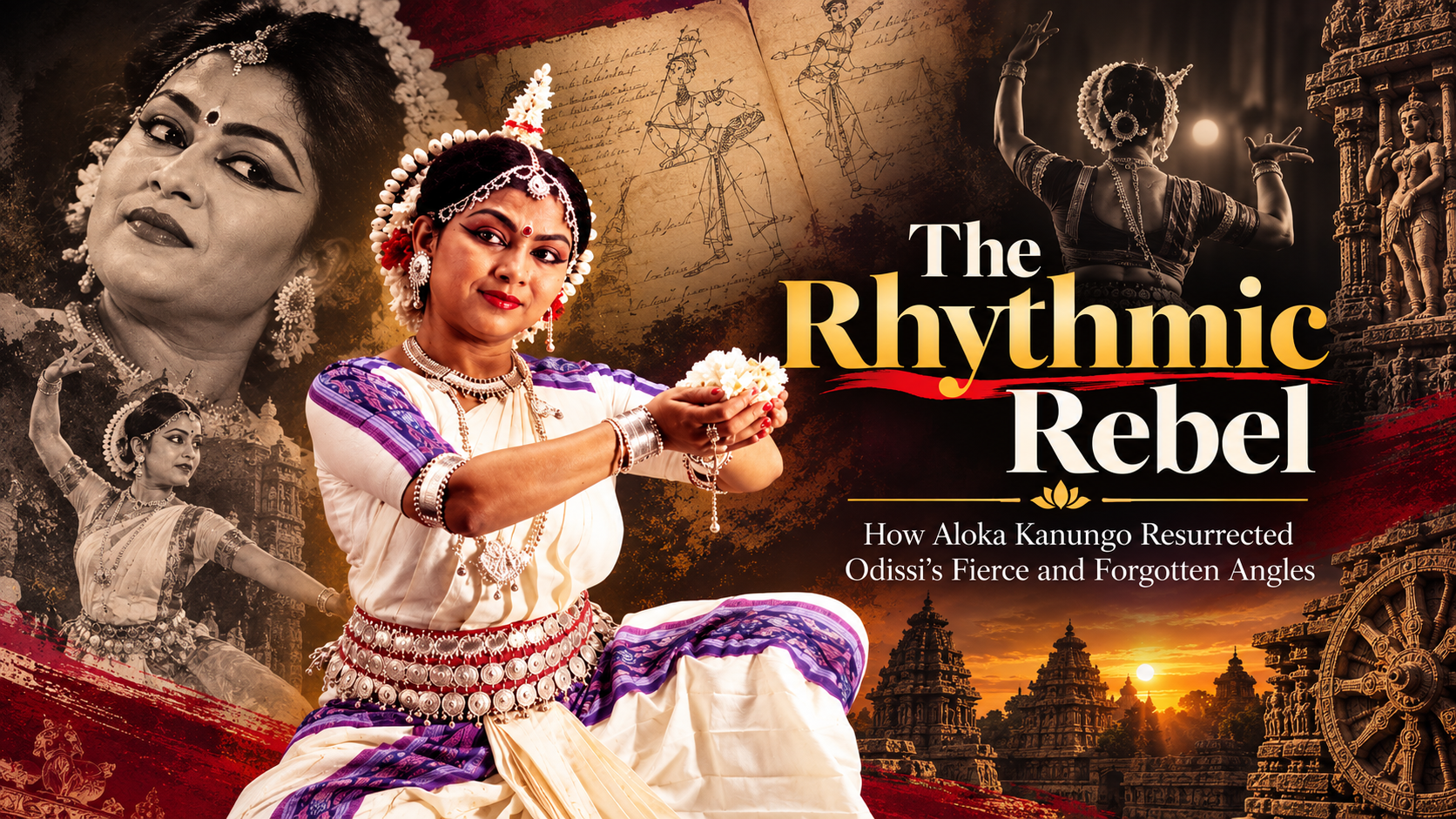
The Rhythmic Rebel
How Aloka Kanungo Resurrected Odissi’s Fierce and Forgotten Angles
When Odissi’s global rise threatened to leave its most ancient, acrobatic roots behind in the dust, one master relocated to Kolkata and merged lyrical grace with forgotten martial thunder.
Taalika Editorial · Friday, 16 October · 3 min read
Every golden age leaves something behind.
By the late twentieth century, Odissi had successfully conquered the global stage. Audiences everywhere were mesmerized by its liquid grace, the sensual curve of Tribhanga, and the intoxicating sweetness of Jayadeva’s Gita Govinda. But in the pursuit of this polished, lyrical beauty, Odissi’s more rugged, primordial elements were quietly slipping into extinction.
The acrobatic contortions of Bandha Nrutya—practiced by the Gotipua boys in village dust—were deemed too raw for elite prosceniums. The fierce, rhythmic chanting of Sabda Swara Pata (powerful syllables praising deities) was rapidly becoming a forgotten relic.
A quiet but profound dilemma haunted the traditionalists: In the rush to make Odissi beautiful and acceptable to the modern world, had the dance sacrificed its ancient, unpolished power?
The Prodigy Who Refused the Safe Path
Guru Aloka Kanungo was not someone who settled for the easy route.
She had been a famous child prodigy in Odisha—a celebrated young actress at All India Radio, Cuttack, and a household name. Yet, she walked away from early fame to surrender completely to the discipline of Odissi, blossoming under the exacting gaze of Guru Kelucharan Mohapatra. She absorbed his legendary, fluid abhinaya, but her restless intellect pushed her further.
When she relocated and established her institution, Shinjan Nrityalaya, she did not choose a safe harbor. She planted her roots in Kolkata—a city fiercely devoted to Rabindra Nritya and Kathak.
There, she asked the pivotal question: How do we bring the fire of the ancient texts back into the classical spine without breaking the grace of the form?
Forging the Forgotten Links
Instead of comfortably recycling the standard syllabus, Kanungo turned her studio into an archaeological dig.
She poured over ancient music treatises and sought out the surviving remnants of Odissi’s martial and Tantric past. She was determined to prove that the dance could be both exquisitely lyrical and terrifyingly powerful.
-
Resurrecting the Sabdas: Kanungo meticulously researched the Sabda Swara Pata—ancient, rhythmic syllables used in praise of deities, which had almost completely lost their glory and true technique. She successfully reintegrated this forgotten, mystical vocabulary back into the modern Odissi repertoire, utilizing compositions by Ramahari Das for monumental productions like Mahavidya.
-
Elevating Bandha Nrutya: She refused to let the acrobatic Bandha Nrutya remain a village novelty. She experimented extensively with both Bandha and Stapatya Satya (sculptural truth), seamlessly weaving acrobatic tension into the refined classical framework of her choreographies.
When her dancers took the stage, audiences expecting only delicate love poetry were suddenly confronted with the raw, explosive Tandava energy of ancient Odisha.
The Kolkata Vanguard
A resurrection only survives if it is inherited.
Through Shinjan Nrityalaya, Kanungo built a formidable army of classical Odissi dancers in the heart of Bengal. Her rehearsal rooms produced not just performers, but rigorously trained teachers and choreographers like Sriparna Bose and Paulami Chakraborty. She empowered the next generation further by instituting the Kalangan Award to support dedicated dance aspirants.
Today, when a dancer seamlessly transitions from a lyrical, weeping Radha into a fierce, acrobatic leap, or strikes the floor to the thunderous, mystic syllables of Sabda Nritya, they are riding the bridge built by Aloka Kanungo. She proved that true preservation doesn't mean locking the past away—it means dragging its fiercest elements into the spotlight and daring the world to look.