Legacy · Odissi
Did Odissi Almost Die?
The evolution of an art form
For centuries, it was locked away in temple ruins and heavily stigmatized by society. Discover how Sanjukta Panigrahi defied tradition to rescue India’s most statuesque dance form from near extinction.
Taalika Editorial · Monday, 5 October · 2 min read
The Forgotten Sculptures of Odisha
Walk through the ancient sun temples of Odisha, and you will see walls covered in breathless stone carvings—dancers captured mid-motion, frozen in intricate, geometric bends. For centuries, these stone figures were the only remaining evidence of a sacred art form. By the mid-20th century, Odissi was a dying dance, heavily stigmatized, hidden away from polite society, and teetering on the edge of total erasure. How did an art form that once communed with the gods become something people actively looked down upon?
Breaking the Silence
The answer to its survival began with a radical act of defiance by a four-year-old girl. In the 1950s, Sanjukta Panigrahi (then Mishra) heard a drumbeat and simply began to move. In a deeply conservative society that viewed dance as an inappropriate pursuit for "respectable" women, her choice to learn was a scandal.
But it raises a crucial question: How do you resurrect a dance when the traditions have been fractured, the teachers are scattered, and the public is actively hostile?
Sanjukta found her anchor in Guru Kelucharan Mohapatra. Together, they treated the revival not just as an exercise in choreography, but as an archaeological excavation. They studied the temple ruins, decoded ancient palm-leaf manuscripts, and painstakingly rebuilt the Tribhanga (three-bend) posture from the literal stones of history.
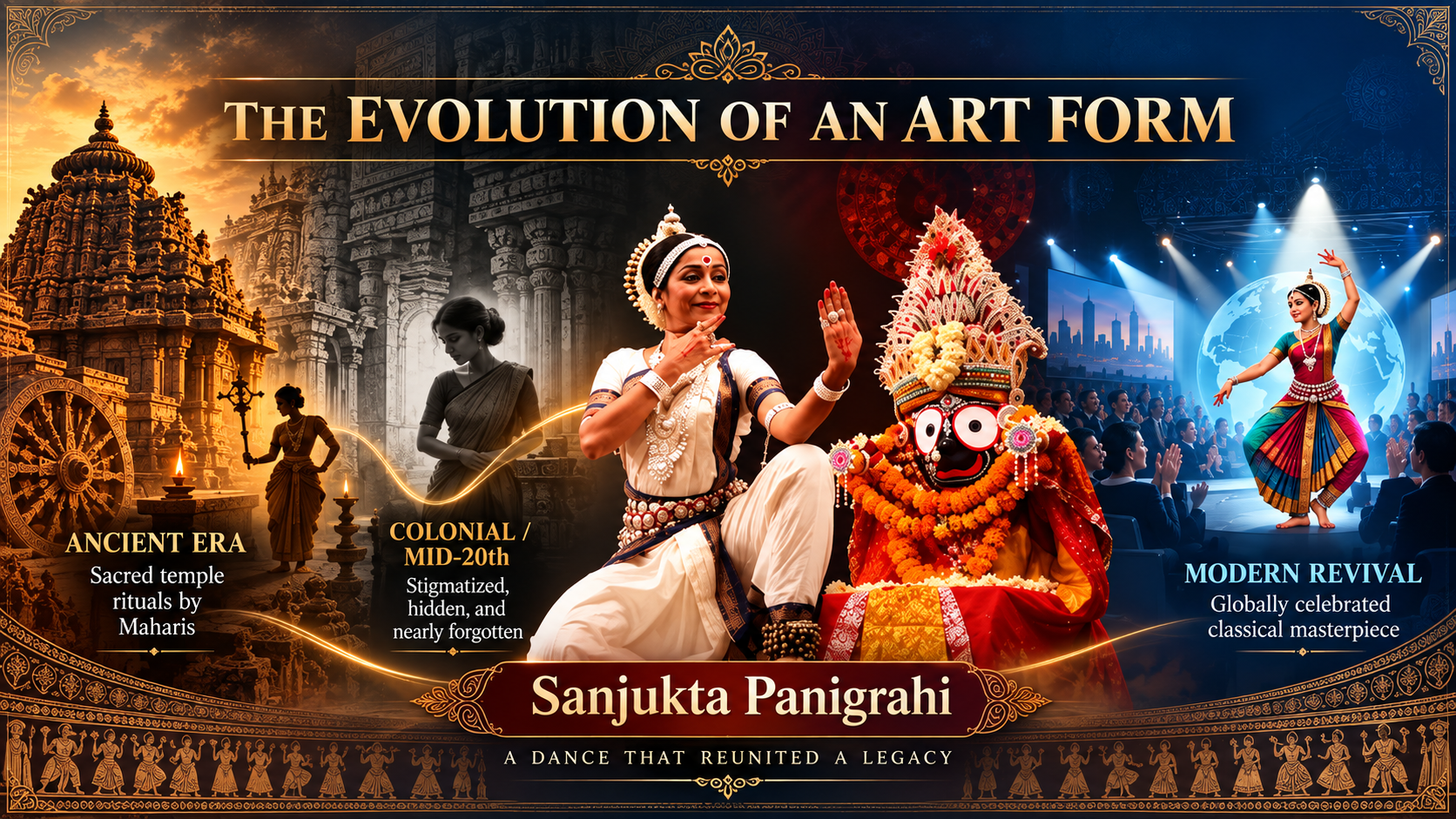
THE EVOLUTION OF AN ART FORM

- Ancient Era: Sacred temple rituals by Maharis
- Colonial/Mid-20th: Stigmatized, hidden, and nearly forgotten
- Modern Revival: Globally celebrated as classical masterpiece
The Great Partnership
A dance, however, cannot live on posture alone; it requires a soul. Sanjukta’s revival found its voice when she married Raghunath Panigrahi, a brilliant vocalist who walked away from a highly lucrative career in Bollywood playback singing to dedicate his life to her vision.
Their partnership answered the ultimate question facing the art form: Can a regional, ritualistic dance survive on the global modern stage?
The turning point came late one night at an international festival in Paris. Facing an audience entirely unfamiliar with Indian classical aesthetics, Sanjukta struck her opening pose—freezing like a living statue from the Konark Temple as Raghunath’s voice pierced the silence. By the time the performance ended, the audience was standing on their seats in tears.
Sanjukta didn't just save a dance; she proved that the ancient stones of Odisha still had a vital story to tell the modern world.