Legacy · Odissi
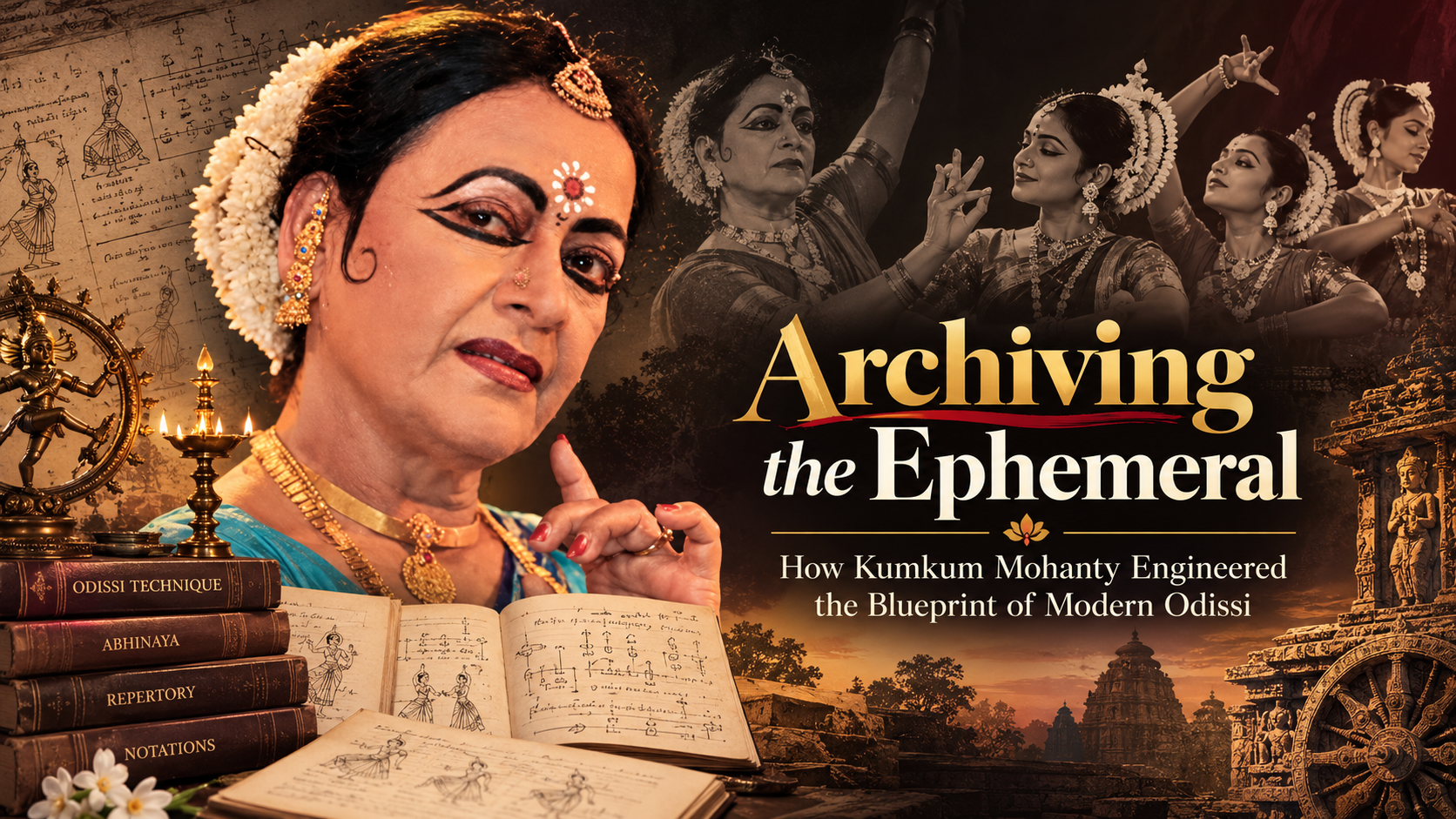
Archiving the Ephemeral
How Kumkum Mohanty Engineered the Blueprint of Modern Odissi
When Odissi’s explosive global popularity threatened to dilute its ancient grammar, one masterful disciple used her bureaucratic might to measure, record, and immortalize the dance before the founding masters passed into history.
Taalika Editorial · Thursday, 3 September · 3 min read
Memory is a fragile vessel for a classical art.
By the late 1970s, Odissi was a global sensation. The relentless struggles of the founding gurus had paid off, and the dance was leaping from the courtyards of Odisha to the prosceniums of New York, Paris, and Tokyo. But with explosive expansion came a quiet, terrifying threat: dilution.
Odissi was still entirely an oral tradition, passed from the guru’s body to the disciple’s eye. As students multiplied and spread across continents, the precise angles of a Chauka or the subtle incline of a Tribhanga began to blur, changing slightly from teacher to teacher.
A heavy, unspoken dilemma hung over the fraternity: When the founding giants are gone, how do we stop the pure, mathematical architecture of Odissi from degrading into a game of Chinese whispers?
The Bureaucrat with a Mahari’s Soul
Kumkum Mohanty saw the crisis approaching.
She was already a legend on stage—one of Guru Kelucharan Mohapatra’s most formidable premier disciples, renowned for her spellbinding, deeply psychological abhinaya. But Mohanty held a second, rarer kind of power. She was a high-ranking civil servant in the Government of Odisha. She understood that passion alone could not protect a legacy; it required institutional iron.
She asked a question that purists found jarring: Can we freeze fluid poetry into a rigid, universal syllabus without killing its soul?
To answer it, she spearheaded the creation of the Odissi Research Centre (ORC) in Bhubaneswar. Her mission was audacious: to extract the genius from the minds of the aging maestros and lock it permanently into a documented, replicable blueprint.
Measuring the Divine
Mohanty transformed the ORC into an unprecedented choreographic laboratory.
She brought her own guru, Kelucharan Mohapatra, alongside scholars and other maestros, and placed the dance under an uncompromising lens. For the first time in Odissi’s history, the ephemeral was quantified.
Mohanty and her team painstakingly documented the exact distances between the heels in a Chauka. They measured the precise degree of the torso’s deflection. They cataloged hundreds of bhangis (postures), mudras (hand gestures), and charis (gaits) that had previously only existed in the muscle memory of a few living men.
She didn't just record the physical movements. She oversaw the exhaustive video archiving of Guru Kelucharan Mohapatra performing his magnum opus abhinayas, ensuring that the micro-expressions of his legendary Ashtapadis were captured on tape before time could steal them away.
The Master Syllabus
The result of this grueling bureaucratic and artistic labor was the Odissi Pathya Kram—a standardized, comprehensive syllabus for Odissi dance.
The critics who feared that codification would turn the dance into sterile mathematics were proven wrong. By establishing a non-negotiable baseline of technique, Mohanty actually liberated future dancers. Once the geometry of the body was perfectly secured by the syllabus, artists were free to pour their entire spirit into the emotion of the performance.
Today, the impact of Kumkum Mohanty’s forgotten architectural labor is invisible, yet omnipresent.
When a young student in a California suburb learns the exact same Bhoomi Pranam as a student in a Cuttack gurukul, they are relying on the bridge Kumkum Mohanty built. She recognized that while the soul of Odissi belongs to the divine, its survival belonged to the archives. By daring to measure the immeasurable, she ensured that the masters’ original fire would never be extinguished.