Legacy · Odissi
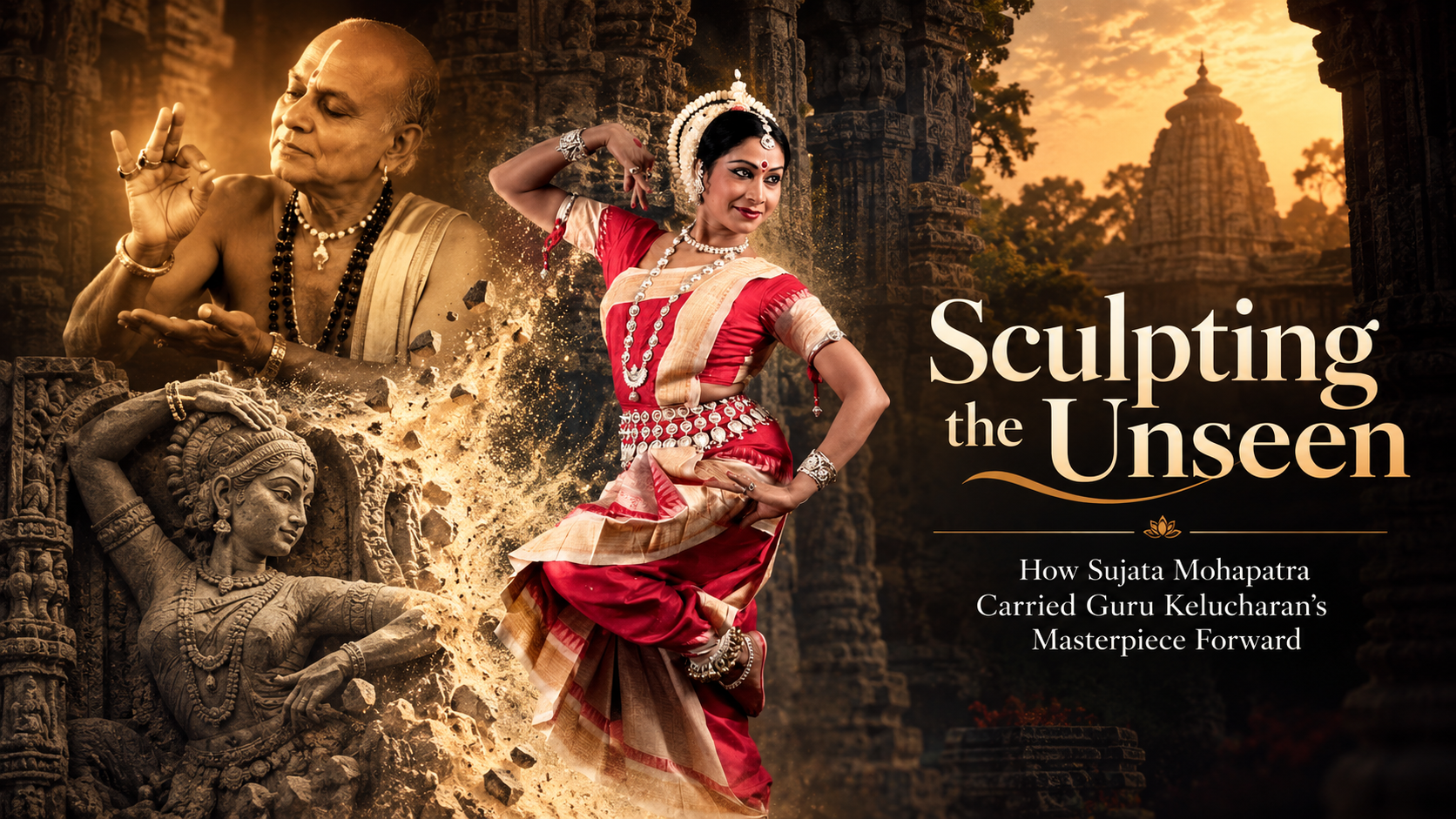
Sculpting the Unseen
How Sujata Mohapatra Carried Guru Kelucharan’s Masterpiece Forward
Walking in the towering shadow of Odissi’s greatest architect, one extraordinary disciple conquered perfectionism to turn stone sculptures into living breath—and passed the torch to a new generation.
Taalika Editorial · Tuesday, 15 September · 3 min read
To inherit a legend is both a gift and an unbearable weight.
When Sujata Mohanty arrived in Bhubaneswar from Balasore in 1987, she stepped into the sanctum of Guru Kelucharan Mohapatra at the Odissi Research Centre. She had rhythm in her veins from her early training under Guru Sudhakar Sahu, but Guruji’s world was different. It was an uncompromising universe of micro-movements, where an angle of the chin or a quiver of the eyelash made the difference between mere gymnastics and spiritual ecstasy.
Soon, she became more than his principal student; she married his son, Ratikant Mohapatra, entering the very heartbeat of the family household.
With that blessing came an agonizing test. Critics watching from the sidelines whispered the question she could never escape: Can she ever be more than a mirror of Guruji? In reproducing his genius, will she lose her own voice?
The Crucible of the Courtyard
The fear was real. Odissi history is filled with brilliant technicians who wilted under the shadows of towering gurus. Replicating Guru Kelucharan’s iconic abhinaya—his tearful Radha, his playful Yashoda, his majestic Dashavatara—seemed impossible for anyone else to truly own.
Sujata chose not to run from the standard. She dissolved herself into it.
Day after day in the rehearsal room at Srjan, through sweltering afternoons and aching joints, she drilled until the technique vanished into instinct. Guruji sat before her with his mardala, stopping her a hundred times for a single glance. He demanded that the dancer become invisible so that only the sculpture remained.
She confronted her doubt by surrendering to the discipline. She realized that imitation is superficial, but deep devotion is alchemy. When she leaned into the deep curve of Tribhanga, it was not a borrowed pose; her body had absorbed the temple friezes of Konark until her breath moved the stone.
The Sculpture That Breathes
By the late 1990s and 2000s, when Guruji could no longer take the stage, it was Sujata who stepped under the spotlights.
Audiences across Paris, New York, and Mumbai gasped. They were not watching a mimic; they were seeing Kelucharan Mohapatra’s masterworks resurrected with an astonishing, razor-sharp geometric precision that was entirely hers. Her lines were cleaner than stone, her speed immaculate, and her bhava so pure that tears sprang unbidden to spectators’ eyes.
She did not freeze the guru's choreography in amber. She burnished it. Through sheer spiritual rigor, she proved that an artist does not need to break the tradition to find liberation—they can achieve transcendence directly through the vessel of lineage.
Passing the Sacred Fire
Yet the true triumph of an artist is never solitary. A legacy confined to one body inevitably ends.
Sujata knew the flame had to travel outward. Alongside her international concert tours, she built a sanctuary of learning:
-
Guru Keerti Srjan: In 2011, she returned to her roots in Balasore, establishing an institute to give small-town youngsters the same rigorous classical training she had received decades earlier.
-
Preetisha Mohapatra: Grooming her daughter as a dynamic third-generation exemplar of the Kelucharan lineage, sharing duets on premier festival stages where mother and daughter reflect the living continuum of the parampara.
-
A Global Classroom: Mentoring scores of rising soloists and teachers across India, the US, and Europe, drilling the exacting nuances of Srjan’s pedagogy into hands and eyes from every corner of the world.
The doubt that once hovered over her journey has long been silenced. In 2017, when the Sangeet Natak Akademi Award recognized her towering contribution, it simply ratified what the dance world already knew.
Sujata Mohapatra did not just preserve a legacy—she became its living proof. Whenever she bows in Bhoomi Pranam, feet rooted and hands cupped in quiet gratitude, she honors the master who carved her, while inspiring the generations who now follow in her footsteps.