Legacy · Odissi
The Architecture of Two
How Surupa Sen Redefined Odissi’s Solitary Soul
For centuries, Odissi was a private conversation between one dancer and the divine. At Nrityagram, one visionary choreographer shattered that isolation, engineering a telepathic duet that forever changed the geometry of the dance.
Taalika Editorial · Monday, 16 November · 3 min read
Historically, Odissi is a profoundly lonely art.
The Mahari danced alone in the shadowed sanctum of the Jagannath Temple. The Gotipua danced as a solitary focal point in the village square. When the founding gurus codified the dance for the modern proscenium, they built the repertoire around the single virtuoso. The stage was a vessel for one ego, one body, one individual yearning for God.
For a young dancer at Nrityagram, this tradition presented a daunting artistic ceiling.
Surupa Sen had absorbed the impeccable, fluid grace of Guru Kelucharan Mohapatra. But her choreographic mind saw beyond the single form. She looked at the empty space on the stage and wondered about the physics of shared movement.
A heavy, unspoken doubt challenged her ambition: If Odissi is fundamentally a solitary, internal communion, what happens when you add another body? Does the deep spiritual intimacy shatter into mere theatrical spectacle?
The Laboratory in the Red Earth
Sen did not seek to dilute the classical grammar; she sought to expand its architecture.
Operating out of Nrityagram—the utopian dance village established by Protima Gauri outside Bengaluru—Sen turned the rehearsal hall into a biomechanical laboratory. She began pulling apart the fundamental stances of Chauka and Tribhanga. She studied the Natya Shastra not just for individual postures, but to understand how bodies could interact, intersect, and breathe as a collective organism.
To test this radical vision, she needed an instrument capable of flawless execution. She found it in Bijayini Satpathy.
The Choreographic Expansion of Surupa Sen at Nrityagram
- Pre-1990s (The Tradition)
- The Artistic Barrier: Odissi repertoire strictly designed for the solo virtuoso.
- Sen's Kinetic Resolution: Mastered the foundational solo grammar under Kelubabu.
- 1990s–2000s (The Laboratory)
- The Artistic Barrier: Duets often looked like two soloists dancing near each other without true interaction.
- Sen's Kinetic Resolution: Engineered 'breath-sync' and complex mirrored geometry.
- 2000s–2018 (The Telepathy)
- The Artistic Barrier: The threat of ensemble work diluting spiritual intimacy.
- Sen's Kinetic Resolution: Created masterful duets like 'Vibhakta' with Bijayini.
- Present (The Architect)
- The Artistic Barrier: Keeping the tradition alive for the next generation.
- Sen's Kinetic Resolution: Expanding the Nrityagram ensemble onto global stages.
The Telepathic Duet
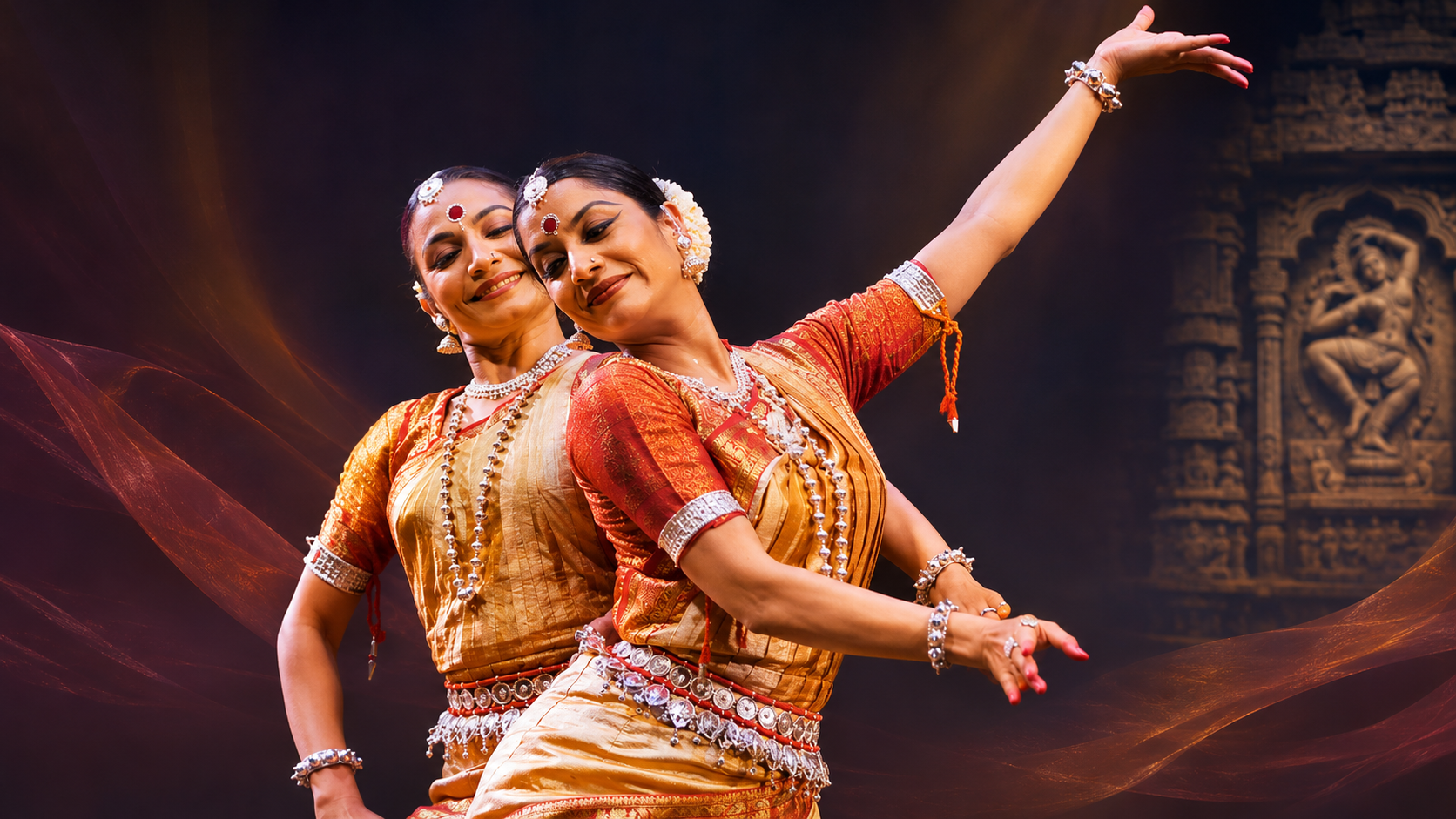
For over two decades, Surupa Sen and Bijayini Satpathy became the most formidable partnership in modern classical dance.
Sen choreographed not for two competing individuals, but for a single soul split across two bodies. The choreography was devastatingly complex. Sen designed movements where the dancers moved in perfect, mirrored symmetry, or in cascading canon, their limbs creating intricate, interlocking mandalas on the stage.
The synchronization went beyond counting beats. It was a cellular, telepathic connection. When one dancer inhaled, the other expanded. When one struck the floor in a fierce Tandava, the other absorbed the kinetic shockwave with lyrical Lasya.
In masterworks like Vibhakta (The Division) and Samhara, audiences from New York to London were paralyzed by the sheer perfection of it. Critics struggled to identify where Sen’s body ended and Satpathy’s began.
A New Classical Canon
Sen brilliantly answered the doubt that shadowed her early career.
She proved that bringing a second body onto the stage does not destroy the spiritual intimacy of Odissi—it multiplies it. The shared gaze, the transfer of weight, and the synchronized breath became a new form of devotion.
While Bijayini Satpathy eventually departed in 2018 to forge her own breathtaking solo path, the architectural blueprint Surupa Sen built remains permanent. Through Sen’s continuing work with the Nrityagram ensemble and dancers like Pavithra Reddy, Odissi is no longer just a solitary prayer. It is a soaring, symphonic chorus, proving that the ancient grammar of the temples is robust enough to hold the weight of a collective dream.