Legacy · Odissi
The Sovereign of Her Feet
How Jayadeva and Padmavati Forged Odissi’s First Blueprint
In the 12th century, Sanskrit poetry belonged to silent palm leaves and rigid royal courts—until a saint-poet from the Prachi Valley began writing to the cadence of his wife’s dancing anklets, giving Odissi its eternal heartbeat.
Taalika Editorial · Monday, 23 November · 4 min read
Before it was ever a scripture, the Gita Govinda was a dance floor.
In the 12th century, classical Sanskrit literature had grown heavy with its own brilliance. Court poets competed in dizzying grammatical acrobatics, crafting intricate verses meant to be admired by scholars in hushed, royal chambers. Poetry was brilliant, polished, and increasingly distant from the pulsing blood of ordinary devotion.
Meanwhile, inside the temples of Kalinga, sacred dance moved to ancient oral rhythms, searching for a literary vessel worthy of its spiritual intensity.
A silent, defining question hung over eastern India’s cultural landscape: Could the high, sacred architecture of Sanskrit poetry ever break free from dead scholarship to sweat, weep, and breathe through a living, dancing body?
The Poet and the Dancer
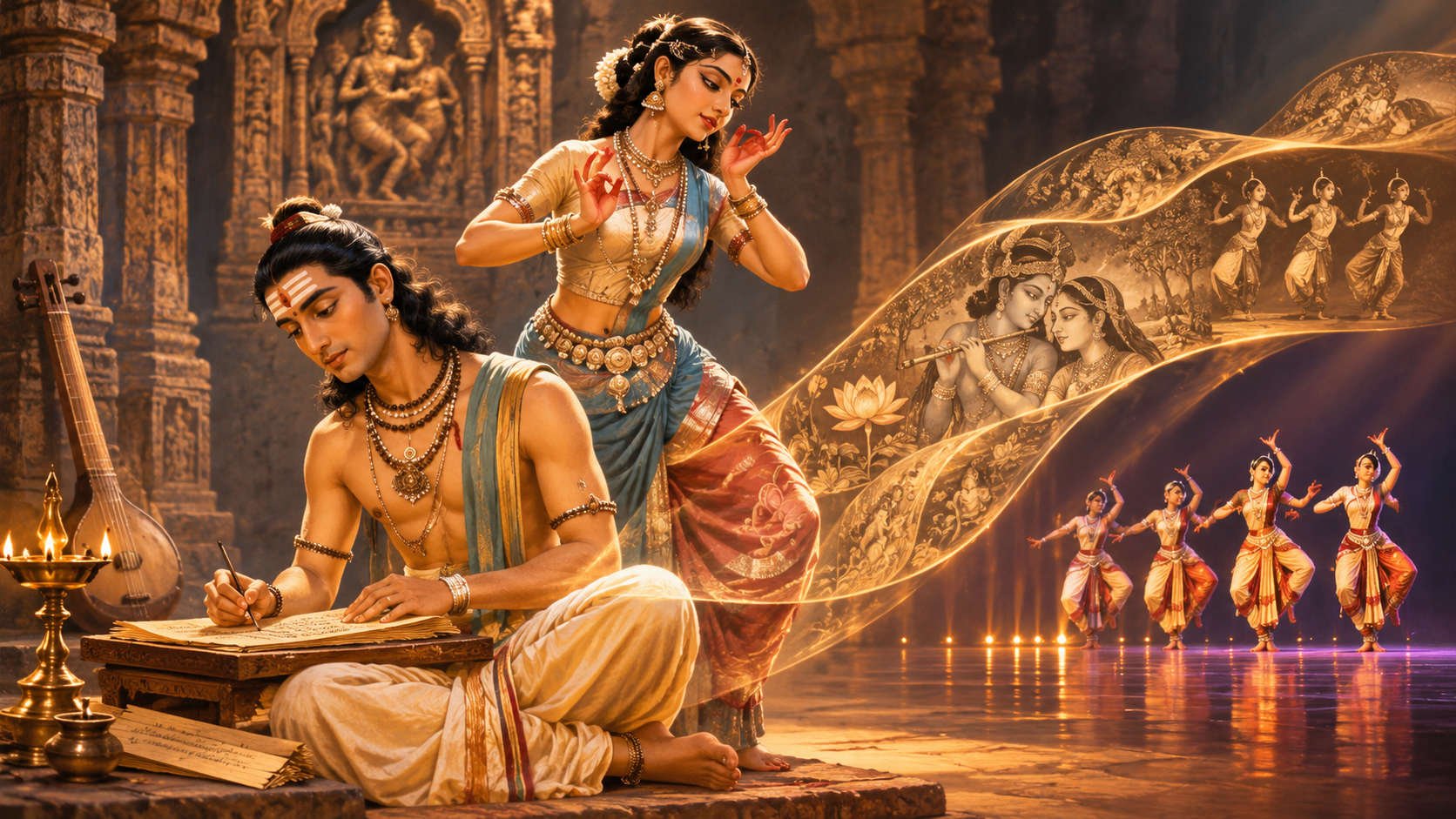
The answer did not emerge from a royal academy. It was born in the intimate partnership of two devotees: the poet Jayadeva, raised in Kenduli Sasan along the lush Prachi Valley, and his wife, Padmavati—an accomplished temple dancer dedicated to Lord Jagannath.
Jayadeva did not write in lonely abstraction. He composed with his eyes fixed on motion.
In the very opening canto of the Gita Govinda, Jayadeva makes a startling declaration. He does not introduce himself as a court panegyrist or a sovereign of grammar. Instead, he proudly crowns himself Padmavati-charana-charana-chakravarti—the supreme director of Padmavati’s dancing feet.
It was a revolutionary confession. The poetry did not dictate the dance; the dance shaped the poetry.
Engineering the Kinetic Verse
Jayadeva treated Sanskrit not as ink, but as percussion.
Watch how his words fall off the tongue: Lalit-lavanga-lata-parishilana-komala-malaya-samire. Even before you translate a single syllable, the alliteration swings like a dancer’s hip in Tribhanga. The vowels stretch like a lingering glance; the consonants strike like bare feet hitting temple stone.
Working alongside Padmavati, Jayadeva engineered a 12-canto, 24-song masterpiece structured into eight-couplet Ashtapadis. He didn't leave the performance to chance. He assigned a specific raga (melody) and tala (rhythmic cycle) to every single song.
More brilliantly, he built the poem as a tight theatrical triangle—Radha, Krishna, and the Sakhi (messenger). This structure forced Padmavati, and every Odissi soloist who followed her, to master rapid psychological transformation: shifting in a single breath from Radha’s burning jealousy to the Sakhi’s gentle persuasion to Krishna’s tender surrender.
From Temple Duet to Classical Canon: The Gita Govinda Arc
- 12th Century (The Blueprint)
- The Cultural Tension: Sanskrit was locked in rigid court scholarship, and dance lacked text.
- The Artistic Breakthrough: Jayadeva wrote directly to Padmavati's dancing rhythm.
- 12th–15th Century (The Sanctum)
- The Cultural Tension: Ritual performances needed deep devotional permanence.
- The Artistic Breakthrough: Gita Govinda Seva entered daily Jagannath Temple worship.
- 1499 AD (The Royal Edict)
- The Cultural Tension: Competing hymns threatened ritual continuity in Puri.
- The Artistic Breakthrough: Gajapati Prataparudra Deva mandated the Gita Govinda by law.
- Modern Revival (The Living Canon)
- The Cultural Tension: Reconstructing Odissi's soul for global proscenium stages.
- The Artistic Breakthrough: Founding gurus built modern abhinaya on the Ashtapadis.
The First Stage: Sanctum of Puri
Their proving ground was the grand Jagannath Temple in Puri.
Legend and temple lore preserve the image of their offering: Jayadeva singing his soaring, hypnotic verses while Padmavati danced before the Dark Lord, both losing all worldly consciousness in the ecstasy of bhava. They did not perform for applause. They turned Shringara—human longing—into the purest form of Bhakti.
The resonance was so overwhelming that it altered Odisha’s history forever. The Gita Govinda became woven directly into the daily rituals of Srimandira, even finding its way onto the sacred silk Khandua draped around Lord Jagannath during the evening Bada Simhara ritual. By 1499, Gajapati Prataparudra Deva carved an inscription onto the Jaya-Vijaya doorway of the temple, mandating by royal decree that only Jayadeva’s verses be sung and danced before the deity.
The Unbroken Echo
Eight centuries later, the partnership of Jayadeva and Padmavati still governs every Odissi stage on earth.
When mid-20th-century masters like Guru Pankaj Charan Das, Guru Kelucharan Mohapatra, and Guru Mayadhar Raut sat down to codify Odissi’s abhinaya, they did not have to invent an emotional vocabulary from scratch. It was already waiting for them inside the Ashtapadis.
Every time a modern dancer pauses in Tribhanga, lifts an eyebrow to trace the longing of Radha in Yahi Madhava, or surrenders to the rhythm of Dashavatara, they are stepping into a blueprint drafted eight hundred years ago—by a poet who listened to his wife’s anklets, and a dancer who gave his words a pulse.