Legacy · Odissi
The Living Shastra
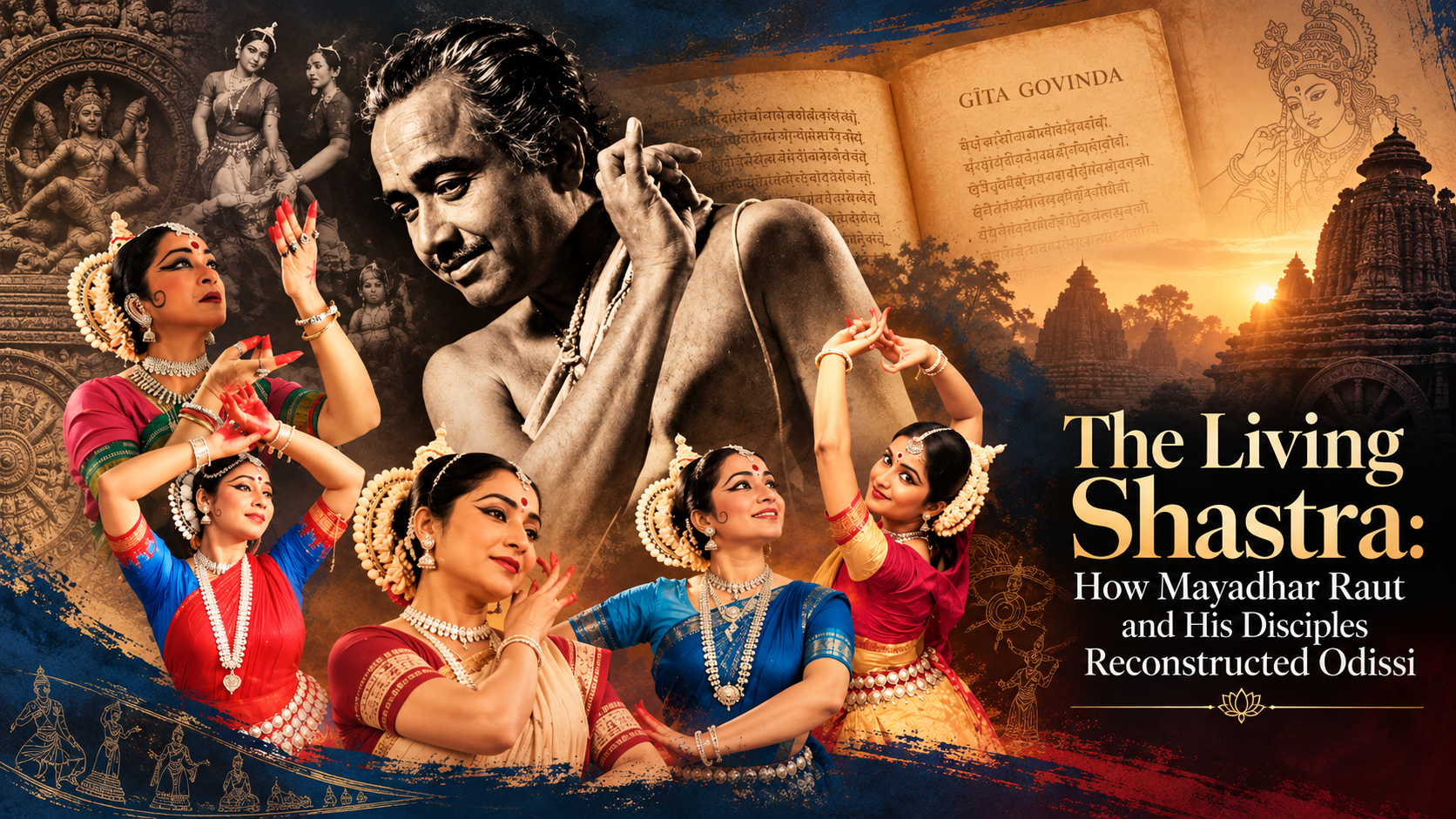
How Mayadhar Raut and His Disciples Reconstructed Odissi
When mid-century critics dismissed Odissi as raw temple theater, one master transformed ancient treatises into a living grammar—arming a circle of pioneering disciples who carried it to the world.
Taalika Editorial · Monday, 10 August · 4 min read
Every classical revival begins with an identity crisis.
In post-independence India, Odissi stood at an agonizing crossroads. The sacred rituals of the Maharis were slowly retreating behind darkened sanctum doors. Gotipua boys still dazzled village courtyards with athletic backbends, but inside the bureaucratic cultural halls of New Delhi, the dance was dismissed as mere regional theater—charming, volatile, and provincial. Odissi brimmed with devotional fire, yet it lacked the one currency the modern world demanded: an undeniable, codified classical grammar.
A restless generation of dancers longed to step under proscenium lights, held back by an unspoken dilemma: If we cannot explain the sacred architecture of our dance, will the world ever grant Odissi the dignity it deserves?
The Master with a Forgotten Map
Mayadhar Raut did not enter this vacuum to perform as a solitary icon. He arrived as a navigator bearing an ancient, half-forgotten map. Reared in the acrobatic endurance of the Gotipua tradition from early childhood, he had traveled south to Kalakshetra in Madras under the watchful eye of Rukmini Devi Arundale. There, immersed in the clean geometric discipline of Bharatanatyam and Kathakali, an epiphany took root. He had no wish to dilute Odissi into a southern imitation; he wanted to restore the structural majesty that was its birthright.
The turning point ignited in September 1959. Late at night, in the ink-scented rooms of Cuttack’s Jayantika collective, Raut sat alongside Kelucharan Mohapatra, Pankaj Charan Das, and Debaprasad Das. The room hummed with tension and cigarette smoke over a single haunting question: How do we preserve the fluid poetry of our curves without degenerating into theatrical mime?
Raut unrolled his answer. Onto the table went worn palm-leaf folios of Maheswara Mahapatra’s 12th-century Abhinaya Chandrika, cross-referenced directly with the Natya Shastra. While others debated instinct, Raut introduced structural law. He chanted and documented the Mudra Viniyoga—the precise Sanskrit slokas that ascribe exact philosophical meaning to every flick of the wrist. He anchored the grounded, masculine square of Chauka against the lyrical, triple-bent grace of Tribhanga. He carved out the Nirdeshika mudra from historical obscurity.
Suddenly, the dance possessed a spine.
The Breathing Scroll
Yet a grammar sealed between manuscript pages cannot breathe. An alphabet is not poetry until voices speak it aloud.
Through the mid-century decades, the path traveled from raw instinct to codified scripture, awaiting the messengers who would set it free. In the early village squares, pure intuition had kept the dance alive, but left it fragile in the face of national neglect. The fiery midnight sessions of Jayantika forged that intuition into gold, proving that ancient texts could anchor living motion. But the ultimate test still lay ahead: could this pristine grammar cross regional borders without freezing into sterile, lifeless technique?
It required a sanctuary where text could turn back into blood.
The Crucible on Delhi’s Stage
That crucible arrived in 1970, when Raut moved to the capital to direct the Odissi wing at Shriram Bharatiya Kala Kendra. His classroom was never a quiet hall of imitation; it was an alchemical forge.
Students walked through his doors full of raw passion, wrestling with how to convey intense spiritual longing without tipping into cheap melodrama. Raut handed them Sanchari Bhava—the demanding art of emotional improvisation. When setting Jayadeva’s Gita Govinda, he forbade simple pantomime. A gesture was not decoration; it was a revelation of the inner psyche. When Radha sang of separation, Raut demanded that her eyes trace not just sadness, but the damp fragrance of the Kadamba groves, the torment of memory, the quiet humiliation of twilight.
His disciples became the living, breathing proof of that vision.
Ranjana Gauhar absorbed his contemplative emotional depth, channeling literary verses into luminous inner monologues that would later command national stages and earn the Padma Shri. Kiren Segal and Aloka Panikar embodied his crisp lyrical line and architectural footwork, establishing Odissi’s presence in auditoriums where Bharatanatyam had long reigned supreme. His daughter, Madhumita Raut, codified and protected his pedagogy, carrying the unvarnished lineage across continents through their family gurukul. Alongside them, dancers like Jayalakshmi Eshwar and Vanashree Rao wove his crystalline geometry into multi-disciplinary classical dialogues, showing that Raut’s vocabulary could match any classical heritage on earth.
The revival was complete.
Without Raut’s textual rigor, Odissi might have remained an endangered regional curiosity. Without his disciples, his sacred formulas would have gathered dust inside museum archives. Instead, the circle joined. Whenever a dancer steps onto the stage today, bends into the lyrical stillness of Tribhanga, or lets an eye flicker with Radha’s unspoken yearning, they speak a language pulled from ancient stone, breathed into life by a master, and kept alive by those who dared to dance his vision.