Legacy · Odissi
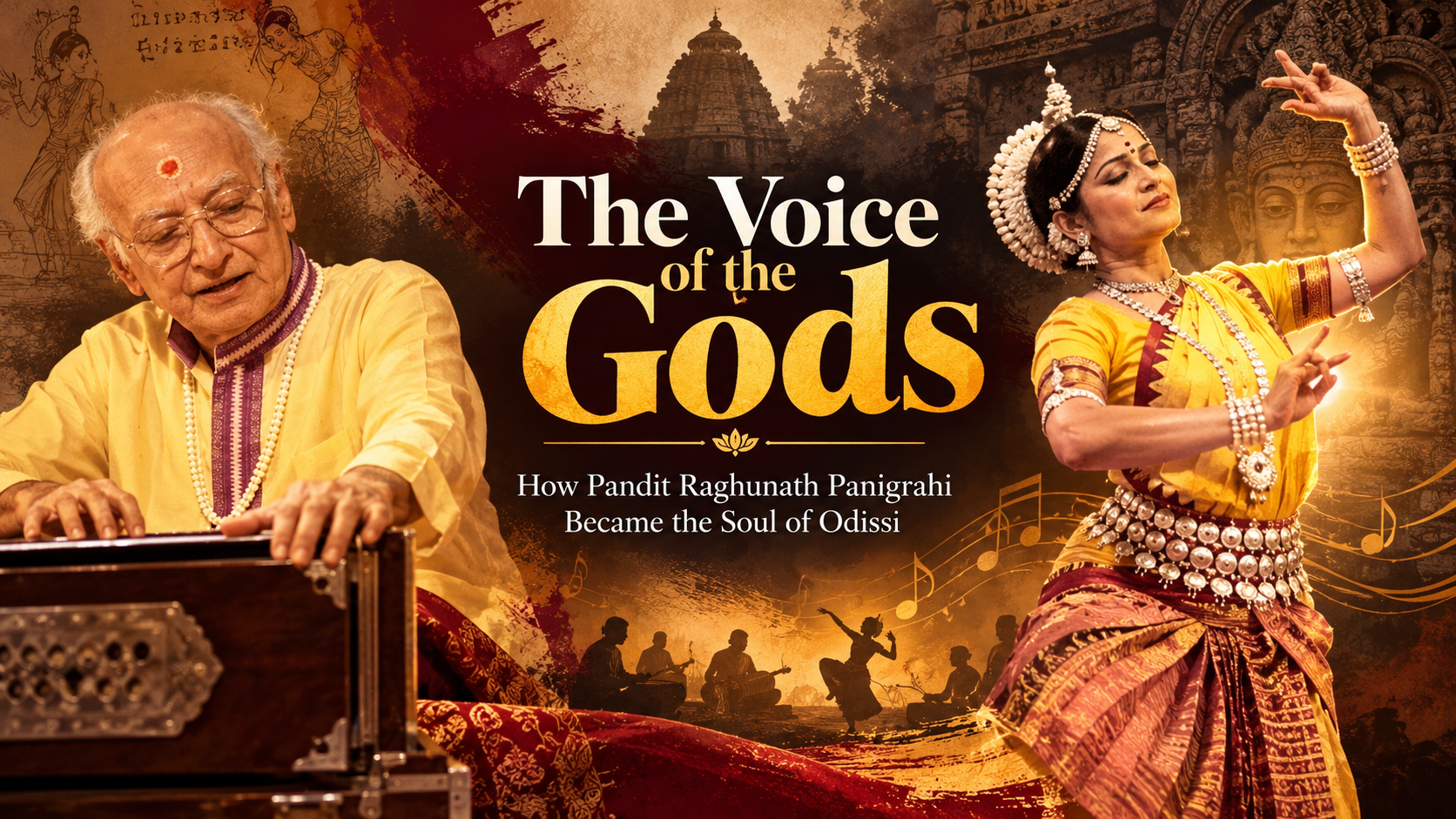
The Voice of the Gods
How Pandit Raghunath Panigrahi Became the Soul of Odissi
When Odissi’s revival focused purely on the dancer's geometry, a rising cinema star abandoned his film career to transform the 12th-century Gita Govinda into the undisputed musical heartbeat of the form.
Taalika Editorial · Monday, 19 October · 2 min read
Every great dance requires a pulse. But for a classical form to transcend mere movement, it requires a soul.
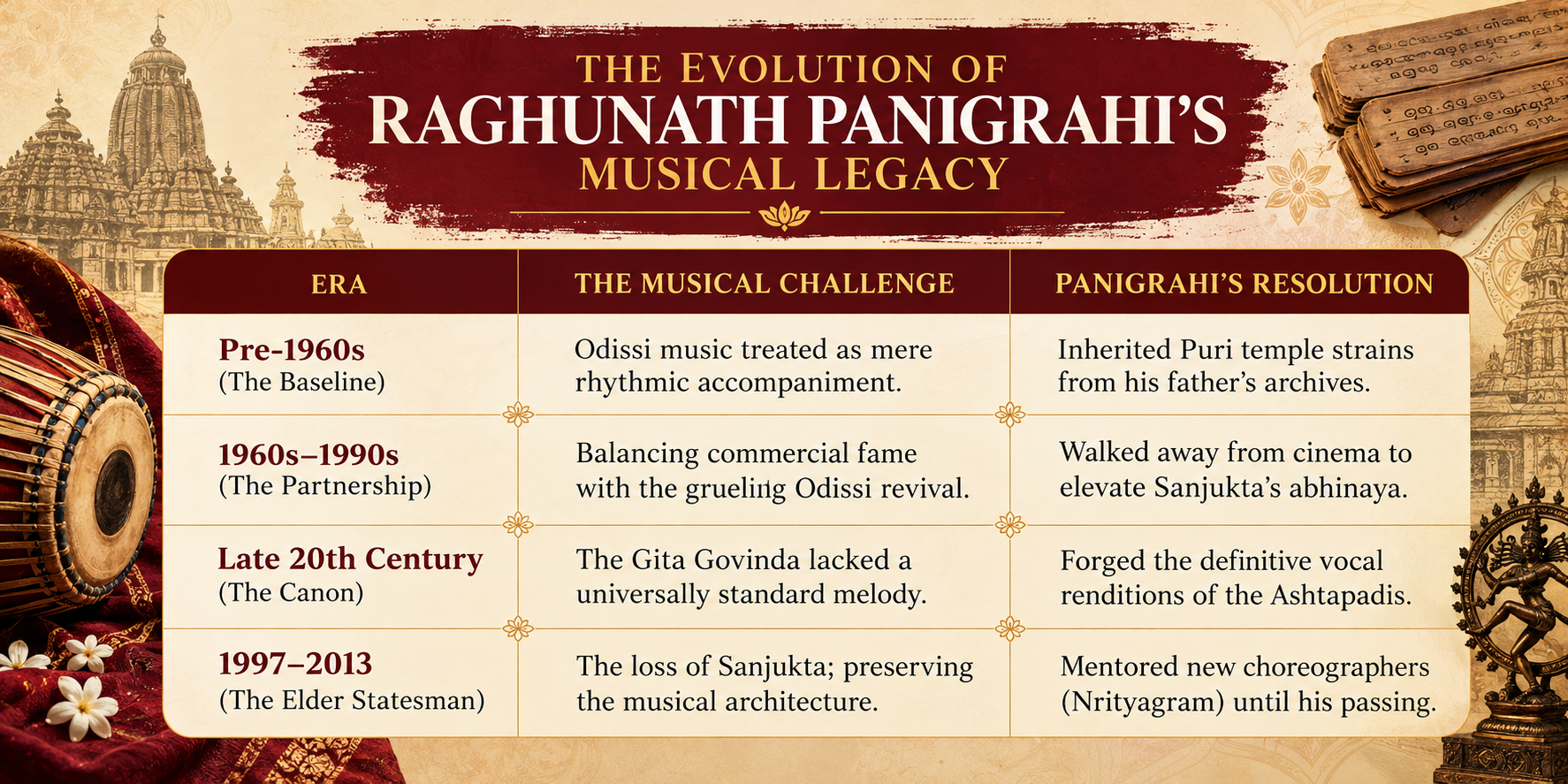
In the mid-20th century, Odissi was fighting to reclaim its architectural dignity. Gurus were painstakingly reconstructing Chauka and Tribhanga from temple carvings. The focus was relentlessly visual. The music, though deeply rooted in tradition, was often treated as secondary—a functional rhythmic accompaniment to anchor the dancer's feet.
A profound dilemma shadowed the music of the revival: If Odissi is to be recognized as a divine classical art, could its vocal tradition ever stand equal to its visual majesty? Or would the singer always be relegated to the shadows of the stage?
The Star Who Walked Away
Pandit Raghunath Panigrahi had every reason to ignore this crisis.
Blessed with a voice of honey and thunder, he was already a rising playback singer in Chennai, lending his vocals to Odia, Kannada, Tamil, and Telugu cinema. He had fame, commercial success, and a glittering future in the film industry. Yet, his blood carried an older, sacred calling. His father, Pandit Neelamani Panigrahi, had spent his life collecting the traditional Odissi melodies of the Gita Govinda directly from the Jagannath Temple in Puri.
When Raghunath married the fiery young danseuse Sanjukta Panigrahi in 1960, he made a decision that shocked the commercial establishment. He walked away from film music. He chose to sit on a humble carpet at the edge of the stage, providing the vocal support for his wife’s Odissi performances.
He didn't just sing for her; he engineered a musical revolution.
Breathing Fire into Jayadeva
Raghunath turned to the 12th-century Sanskrit masterpiece, Jayadeva’s Gita Govinda.
Before him, the Ashtapadis were often sung in disjointed or overly simplified melodies. Raghunath dipped into his father’s temple archives and his own rigorous classical training to craft compositions that didn't just support the dance—they commanded it.
When Sanjukta leaped into an aggressive Tandava, Raghunath’s voice summoned the storm. When she sank into the despair of a separated Radha, his voice broke with such exquisite, unvarnished agony that audiences wept before the dancer even moved.
The Title That Eclipsed His Name
He became so synonymous with these ancient verses that the public and the fraternity affectionately christened him "Gitagobinda Panigrahi". Together, Sanjukta and Raghunath formed the most formidable partnership in Indian classical history—her Laya (rhythm) perfectly matched by his Sur (melody).
Even after Sanjukta’s tragic passing in 1997, his music did not fall silent. He continued to compose, collaborating with institutions like Nrityagram to build sweeping, romantic soundscapes for a new generation of dancers.
By the time he passed away in 2013, Pandit Raghunath Panigrahi had definitively answered the dilemma of his youth. Odissi’s music was no longer in the shadows. He proved that the dancer and the singer are not master and servant, but twin flames—and that the Gita Govinda, when sung with true devotion, can open the gates of heaven.