Legacy · Odissi
The Architect of Sun and Stone
How Guru Gangadhar Pradhan Built an Odissi Empire from the Dust
When classical dance retreated into the comfort of elite metropolitan auditoriums, a former Gotipua dancer from a remote island risked everything to build a democratic academy and an impossible open-air festival in the shadow of Konark.
Taalika Editorial · Saturday, 31 October · 4 min read
Every art form needs its purists and its poets. But to survive the centuries, an art form also needs an architect.
By the late 1970s, Odissi was securing its golden era. The foundational gurus had codified the grammar, and elite soloists were taking the dance to proscenium stages in New Delhi, New York, and Paris. The revival was a triumph, but a quiet danger was creeping in: exclusivity. Odissi was migrating into highly selective, state-funded academies. It was becoming polished, distant, and aristocratic.
In the midst of this gentrification stood Guru Gangadhar Pradhan.
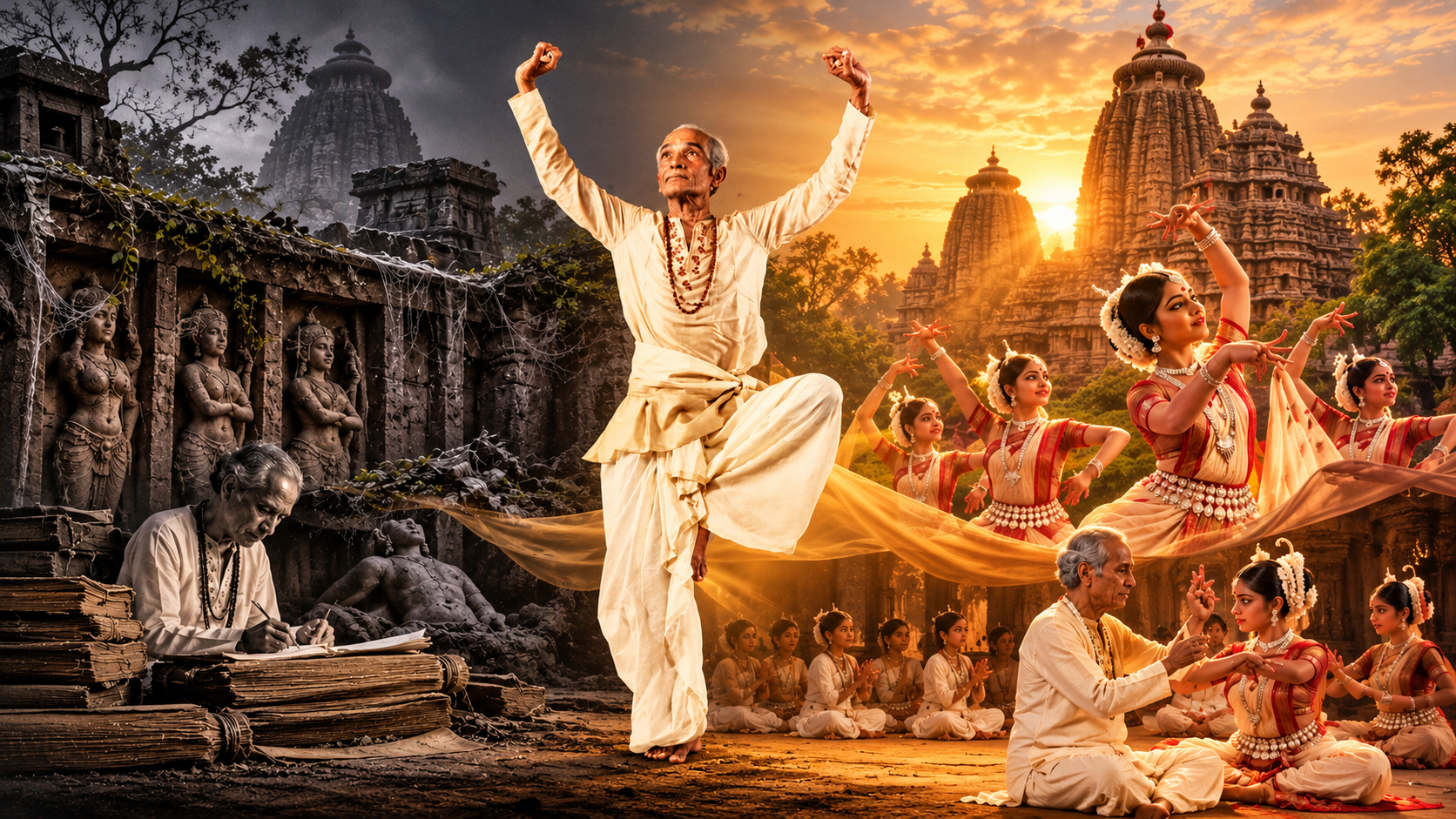
He was not born into cultural royalty. He came from Parikud, a remote, flood-prone island in the Chilika Lake. Dedicated to the temple as a young boy, he had learned the dance in the dust as a Gotipua acrobat. He carried the raw, unvarnished pulse of rural Odisha in his veins. As he watched the dance become increasingly elite, a profound, agonizing question haunted him:
If Odissi becomes the exclusive property of metropolitan elites, will it lose its spiritual connection to the masses? And how can a village boy with empty pockets build a sanctuary large enough to protect the dance for everyone?
The Democratic Fortress: Orissa Dance Academy
Gangadhar Pradhan answered that doubt in 1975 by doing something radical. He founded the Orissa Dance Academy (ODA) in Bhubaneswar.
He did not want a boutique school that produced one or two star soloists a decade. He wanted a sprawling, democratic fortress. Pradhan opened his doors to everyone. He believed that the discipline of Odissi should be accessible to the middle class, the rural child, and the international seeker alike.
His rehearsal halls were chaotic, vibrant, and overflowing. He possessed an uncanny, eagle-eyed ability to spot raw talent in a crowded room, nurturing prodigious disciples like Padmashri Aruna Mohanty, who would eventually stand by his side to help shoulder the massive institutional weight of ODA. Under his relentless drive, the academy grew into the largest Odissi institution in the world, churning out a disciplined army of dancers, choreographers, and teachers who flooded the global diaspora.
He had secured the future of the dancers. But they needed a stage worthy of the gods.
The Madness of the Konark Dream
If ODA was his logical masterstroke, the Konark Natya Mandap was his magnificent madness.
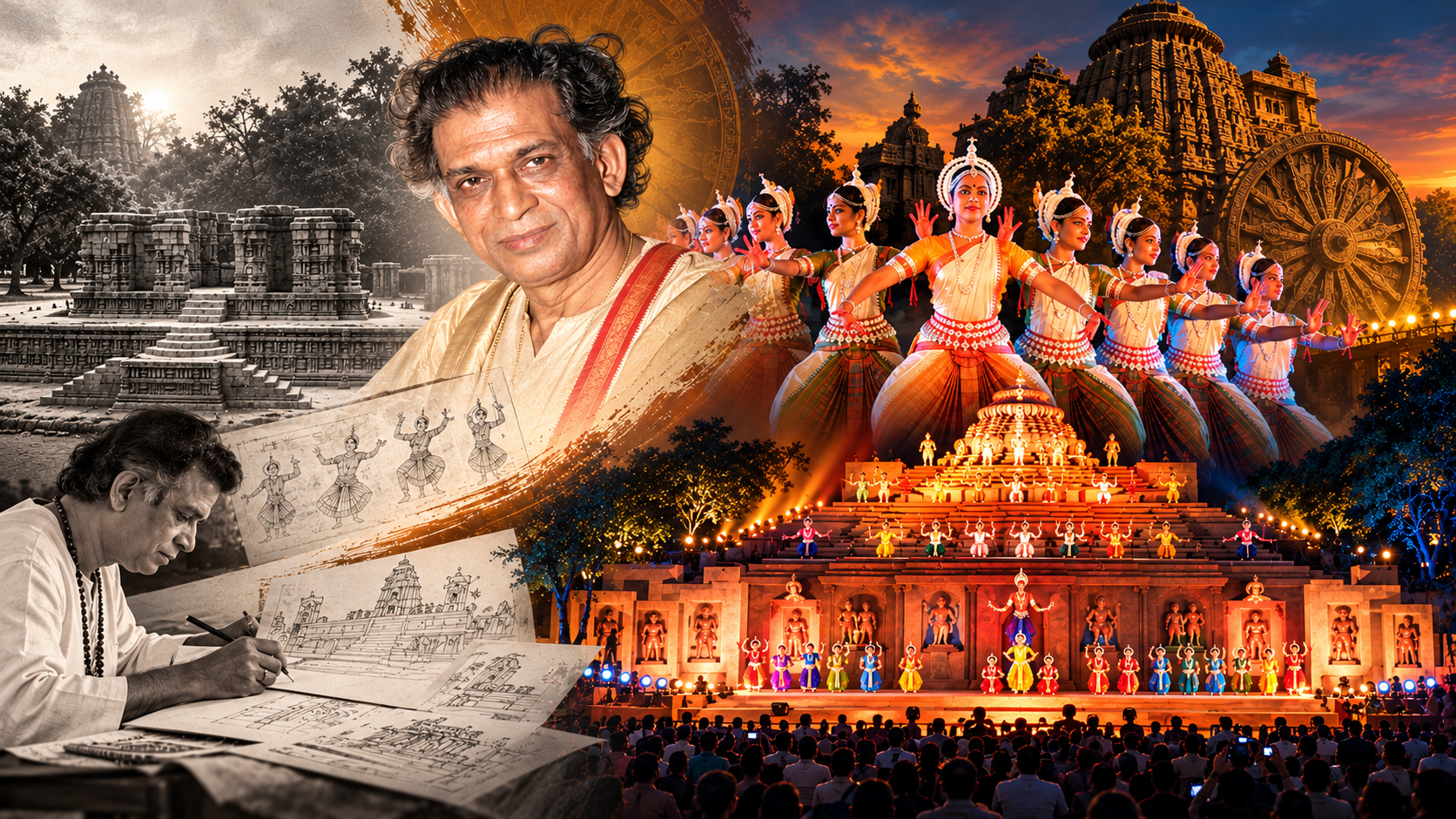
Pradhan looked at the 13th-century Sun Temple of Konark—a ruined masterpiece of laterite and khondalite stone. The original Natya Mandap (dancing hall) stood silent, its sculptures frozen in time. To everyone else, it was an archaeological site. To Pradhan, it was an empty stage waiting to be woken up.
He envisioned a grand, open-air amphitheater built as a living replica of the Sun Temple's dancing hall, where the greatest classical artists of India would perform beneath the stars.
The cultural establishment scoffed. It was the mid-1980s. Konark was practically a barren, isolated village after sundown. There were no luxury hotels, no proper roads, and no state budget for an independent guru’s extravagant dream. How would he fund it? How would he attract international audiences to a mosquito-ridden coastal scrubland?
Brick by Brick: The Struggle for Scale
Pradhan did not wait for government committees to approve his vision. He simply went to work.
He acquired a patch of barren land a few kilometers from the Sun Temple. Operating on a shoestring budget, he poured every rupee he earned from teaching and touring into the soil. When the money ran out, he mortgaged his personal assets. When labor was scarce, the maestro of Odissi picked up bricks and worked alongside the masons in the blistering coastal heat.
The early years of the Konark Dance and Music Festival were a logistical nightmare. Pradhan would personally run between arranging transport for legendary musicians, fixing makeshift stage lights that flickered in the coastal wind, and sweeping the stage before the curtain rose. He convinced titans of Indian classical music and dance to travel to this remote outpost, paying them not with lavish cheques, but with the sheer gravitational pull of his passion.
He wasn't just building a stage; he was engineering a pilgrimage.
Slowly, the impossible began to take shape. The stone arches rose. The village awoke. Audiences, at first a trickle of curious locals, turned into a flood of international connoisseurs. The rhythmic strike of the mardala and the melodic wail of the sitar began to echo through the casuarina trees, breathing life back into the silent stone dancers of the nearby temple.
An Empire of Sweat and Stone
Today, the scale of what Guru Gangadhar Pradhan achieved borders on the mythical.
The Orissa Dance Academy remains a colossal powerhouse, its alumni serving as the cultural ambassadors of Odisha across every continent. The Konark Natya Mandap stands as a vibrant, living monument, hosting a festival that is permanently etched into the global cultural calendar.
He answered the doubt of his youth with resounding, structural permanence. Guru Gangadhar Pradhan proved that Odissi does not need to be locked in a sterile auditorium to be respected. By marrying the fierce, democratic grit of a village Gotipua with the visionary scale of a master architect, he ensured that Odissi would forever dance under the open sky.